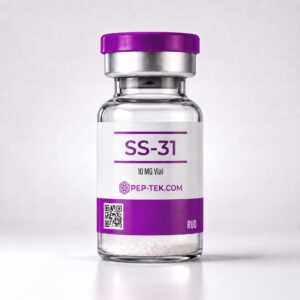
Available from PepTek
SS-31 is a mitochondria-targeting peptide studied for its selective interaction with cardiolipin in the inner mitochondrial membrane, with research suggesting roles in bioenergetics and oxidative stress.
Among the most studied mitochondria-targeting compounds in contemporary biomedical research, SS-31 (also designated Elamipretide or MTP-131) represents a tetrapeptide with a unique structural affinity for the inner mitochondrial membrane. Research into SS-31 cardiolipin mitochondrial membrane research has generated substantial interest in understanding how small peptides can selectively localize to mitochondria and modulate bioenergetic function at a molecular level. This profile reviews the structural basis of that interaction, the research history behind SS-31, and the body of evidence accumulated across cell and animal model studies.
SS-31 is a member of the Szeto-Schiller (SS) peptide family, a series of aromatic-cationic tetrapeptides developed to exploit the large electrochemical gradient across the inner mitochondrial membrane. Its sequence — D-Arg-2′6′-Dmt-Lys-Phe-NH2 — incorporates alternating aromatic and cationic residues, a structural motif researchers have identified as critical for membrane partitioning and cardiolipin binding.
The alternating charge-aromatic pattern allows SS-31 to accumulate at the inner mitochondrial membrane with an estimated concentration several hundredfold greater than that in the cytoplasm [Szeto, 2014]. This property distinguishes it from earlier mitochondria-targeted antioxidants that relied on lipophilicity or triphenylphosphonium conjugation, which tend to accumulate broadly in lipid membranes rather than selectively at the inner leaflet.
Cardiolipin is a unique dimeric phospholipid found almost exclusively in the inner mitochondrial membrane, where it constitutes approximately 20% of total lipid content. Its distinctive bis-phosphatidylglycerol structure carries two phosphate groups and four acyl chains, enabling it to coordinate with a variety of mitochondrial proteins. Cardiolipin is considered essential for maintaining the structural integrity of the cristae and for supporting the function of the electron transport chain (ETC) complexes embedded within the inner membrane.
Research has established that cardiolipin acts as a scaffold for supercomplexes — organized assemblies of ETC complexes I, III, and IV — that are thought to enhance electron transfer efficiency and reduce electron leak [Mileykovskaya & Dowhan, 2014]. Disruption of cardiolipin, whether through oxidation, remodeling defects, or redistribution to the outer membrane, has been associated with impaired mitochondrial respiration in model systems.
The central finding driving SS-31 cardiolipin mitochondrial membrane research is that SS-31 binds directly and selectively to cardiolipin via electrostatic interactions between its cationic lysine and arginine residues and the anionic phosphate head groups of cardiolipin, complemented by hydrophobic insertion of its aromatic residues into the acyl chain region. Biophysical studies using surface plasmon resonance and isothermal titration calorimetry have confirmed high-affinity binding between SS-31 and cardiolipin-containing liposomes [Birk et al., 2013].
This interaction appears to stabilize cardiolipin in the inner membrane leaflet and prevent its peroxidation by cytochrome c — a process researchers have identified as a key amplification step in apoptotic signaling. Under conditions of cellular stress, cytochrome c can transition from its role as an electron carrier to a cardiolipin peroxidase, generating lipid hydroperoxides that permeabilize the outer mitochondrial membrane. In vitro evidence suggests SS-31 competitively inhibits this peroxidase activity by occupying the cardiolipin binding interface of cytochrome c [Birk et al., 2013].
The SS peptide family was first described by Hazel H. Szeto and Peter W. Schiller in the early 2000s, initially characterized for their opioid receptor interactions before researchers recognized their exceptional mitochondrial accumulation properties. Subsequent investigations redirected focus toward their bioenergetic effects.
Early cell-free and cell culture experiments demonstrated that SS-31 could preserve mitochondrial membrane potential and ATP synthesis under conditions of simulated ischemia-reperfusion. These observations catalyzed a broader research program exploring SS-31 cardiolipin mitochondrial membrane research across multiple model systems. The compound’s structural simplicity and aqueous solubility made it amenable to a wide range of experimental preparations, contributing to a rapid accumulation of preclinical data across cardiac, renal, skeletal muscle, and neurological research contexts.
Research parallels exist with other mitochondrially relevant compounds. For instance, studies on NAD+ as a coenzyme in cellular metabolism have similarly focused on how supporting electron transport chain function and mitochondrial biogenesis may influence cellular energetics in model systems. Likewise, glutathione tripeptide research in redox signaling provides complementary context for understanding how small peptide structures can engage directly with oxidative stress pathways at the subcellular level.
Multiple animal model studies have investigated whether SS-31 influences oxygen consumption rates and ATP production in isolated mitochondria and intact cells. Researchers have observed that SS-31 treatment in rodent models of cardiac ischemia-reperfusion injury was associated with preserved mitochondrial ultrastructure and higher post-ischemic ATP levels compared to vehicle controls [Szeto et al., 2011]. Electron microscopy data from these studies revealed maintenance of cristae morphology — the folded inner membrane structures whose integrity is closely tied to cardiolipin content and distribution.
A notable area of SS-31 cardiolipin mitochondrial membrane research concerns its effects on mitochondrial reactive oxygen species (ROS) generation. Rather than acting as a direct ROS scavenger — a mechanism attributed to some earlier antioxidant compounds — SS-31’s interaction with cardiolipin is hypothesized to reduce electron leak from complex I and complex III by stabilizing supercomplex architecture. In vitro studies using isolated cardiac mitochondria have reported reduced superoxide generation following SS-31 treatment under substrate-overload conditions [Szeto, 2014].
Animal model investigations have extended to age-related changes in skeletal muscle mitochondria, where cardiolipin content and acyl chain composition are known to shift with aging. Studies in aged rodents treated with SS-31 reported improvements in mitochondrial oxygen flux and muscle force production, with researchers attributing these effects to restoration of cardiolipin-dependent supercomplex assembly [Siegel et al., 2013]. These findings have positioned SS-31 cardiolipin mitochondrial membrane research as a useful model for studying mitochondrial remodeling during biological aging in preclinical settings.
Beyond cardiac and skeletal muscle contexts, preclinical studies have examined SS-31 in models of acute kidney injury and metabolic dysfunction. Researchers have observed that SS-31 treatment in murine cisplatin nephrotoxicity models was associated with reduced tubular cell apoptosis and preserved renal mitochondrial membrane potential, consistent with its proposed cardiolipin-stabilizing mechanism. The intersection of mitochondrial function and metabolic regulation continues to attract research attention, with comparisons drawn to compounds studied in metabolic contexts such as those profiled in Tirzepatide GLP-1/GIP dual agonist research.
SS-31 is frequently compared within research contexts to other bioactive peptides that exert cytoprotective effects through indirect or structural mechanisms rather than classical receptor agonism. The GHK-Cu copper peptide, for example, has been studied for its involvement in cellular repair signaling pathways, and researchers interested in peptide-mediated cellular protection may find value in reviewing GHK-Cu copper peptide research and signaling pathways as a complementary area of study.
SS-31’s tetrapeptide structure also invites methodological comparisons with other short synthetic peptides studied for targeted biological effects, highlighting the broader principle that precise amino acid sequencing can direct compounds to specific subcellular compartments without requiring large macromolecular scaffolds.
While the preclinical evidence base for SS-31 is substantial, researchers have noted several areas requiring further investigation. The precise stoichiometry of SS-31-cardiolipin interactions under physiological membrane conditions remains an active area of biophysical research. Additionally, the relative contributions of cardiolipin peroxidase inhibition versus supercomplex stabilization to observed bioenergetic effects have not been fully delineated in intact cell systems. Translational research has progressed to clinical trial stages for selected indications, though outcomes from those studies do not inform the preclinical mechanistic questions that remain central to the research community’s interest in this compound.
SS-31 is an active subject of investigation in mitochondrial biology, cardiolipin biochemistry, and bioenergetics research. The mechanistic insights derived from SS-31 cardiolipin mitochondrial membrane research continue to contribute to the broader understanding of how inner mitochondrial membrane lipid architecture regulates energy transduction and oxidative stress responses at the cellular level.
Research Use Disclaimer: All information presented in this article is intended strictly for scientific research and educational purposes. SS-31 is a research compound supplied exclusively for use in controlled laboratory and preclinical research settings. It is not approved for human or animal consumption, is not intended for therapeutic, diagnostic, or clinical use, and should not be administered to humans or animals outside of properly sanctioned research protocols. PepTek provides research compounds solely to qualified researchers operating within applicable regulatory frameworks. Nothing in this article constitutes medical advice, a therapeutic claim, or a recommendation for any clinical application.