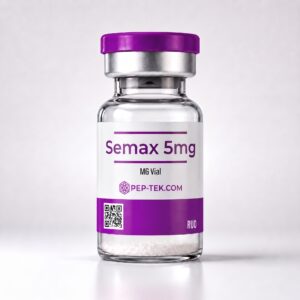
Available from PepTek
Semax is an ACTH-derived heptapeptide studied for its interactions with melanocortin receptors and neuroprotective signaling pathways in preclinical research models.
Semax represents one of the most extensively studied synthetic neuropeptides derived from the adrenocorticotropic hormone (ACTH) sequence. As researchers continue to investigate the molecular pharmacology underlying its observed effects in preclinical models, the compound’s interactions with the melanocortin receptor system have emerged as a central area of inquiry. Understanding the semax ACTH melanocortin receptor research mechanism requires examining both its structural origins and the downstream signaling cascades that have been characterized in laboratory settings.
For a broader overview of Semax’s general research profile, PepTek’s article on Semax as an ACTH-derived neuropeptide provides foundational context on its discovery, structural characteristics, and the range of in vitro and animal model studies conducted to date.
Semax (Met-Glu-His-Phe-Pro-Gly-Pro) is a heptapeptide analogue derived from the 4–10 fragment of ACTH, a 39-amino-acid peptide hormone produced in the anterior pituitary gland. Researchers in the Soviet Union, primarily at the Institute of Molecular Genetics in Moscow, first synthesized Semax in the 1980s as part of efforts to create stable, bioactive fragments of ACTH with enhanced resistance to enzymatic degradation [Ashmarin et al., 1997].
The parent molecule, ACTH, exerts its primary physiological actions through the melanocortin receptor family — a group of G protein-coupled receptors (GPCRs) that includes five subtypes (MC1R through MC5R). The ACTH(4–10) sequence, which forms the backbone of Semax, retains critical residues — particularly the His-Phe-Arg-Trp motif conserved across melanocortin-active peptides — that are recognized as pharmacophores for melanocortin receptor interaction. Semax substitutes and extends this sequence to improve metabolic stability while preserving receptor engagement capacity.
The melanocortin receptor family mediates a diverse range of biological processes, with individual subtypes distributed across distinct tissue compartments. MC1R is predominantly expressed in melanocytes; MC2R is the canonical ACTH receptor expressed in the adrenal cortex; MC3R and MC4R are highly expressed in the central nervous system; and MC5R is found in exocrine glands. Research investigating the semax ACTH melanocortin receptor research mechanism has focused particularly on MC4R activity within the brain, where in vitro binding assays and animal models suggest Semax may exert its most significant observed effects [Dolotov et al., 2006].
Unlike full-length ACTH, which engages both MC1R and MC2R with high affinity, ACTH-derived fragments containing the 4–10 sequence show reduced efficacy at MC2R — the primary steroidogenic receptor — while retaining activity at neuronal receptor subtypes. This differential selectivity is of significant research interest because it suggests that compounds like Semax may be studied for central nervous system-relevant effects without the steroidogenic actions associated with native ACTH.
Researchers studying other melanocortin receptor agonists have explored parallel receptor pharmacology. PepTek’s profile on Melanotan II as a melanocortin receptor agonist provides a comparative perspective on how different structural variants engage melanocortin receptor subtypes with varying potency and selectivity profiles.
Melanocortin receptors signal primarily through Gs-coupled pathways, activating adenylyl cyclase and elevating intracellular cyclic adenosine monophosphate (cAMP) concentrations. Elevated cAMP activates protein kinase A (PKA), which in turn phosphorylates the cAMP response element-binding protein (CREB) — a transcription factor critically involved in neuroplasticity, learning, and cell survival signaling [Grigoryan et al., 2008].
In animal model studies, Semax administration has been associated with upregulation of brain-derived neurotrophic factor (BDNF) and its receptor TrkB in hippocampal tissue. Researchers propose that this BDNF modulation may occur downstream of MC4R-mediated cAMP/PKA/CREB activation, representing a secondary mechanism through which the primary semax ACTH melanocortin receptor research mechanism may propagate broader neuroprotective signaling [Dolotov et al., 2006].
Beyond direct receptor engagement, preclinical research has examined how Semax interacts with oxidative stress pathways in neural tissue. Studies in rodent models of ischemia have reported alterations in reactive oxygen species (ROS) levels and antioxidant enzyme activity in brain regions following Semax administration [Filippenkov et al., 2020]. These observations suggest potential crosstalk between melanocortin receptor signaling and endogenous antioxidant defense systems.
The relationship between peptide signaling and redox biology is an active area of research across multiple compound classes. Researchers interested in redox signaling mechanisms may find comparative insights in PepTek’s research article on glutathione as a tripeptide antioxidant and redox signaling molecule, which examines how small peptides interface with cellular oxidative stress responses.
Animal model research has also documented Semax-associated changes in monoamine neurotransmitter systems. Studies in rats have reported modifications in serotonin turnover in the frontal cortex and hippocampus following administration of ACTH(4–10) analogues, an observation consistent with known melanocortin-monoamine system crosstalk in the brain [Ashmarin et al., 1997]. Additionally, MC4R activation has been linked in separate research to modulation of dopaminergic tone in mesolimbic circuits — a finding that has expanded the mechanistic framework for studying ACTH-fragment peptides in CNS research models.
In vitro research using hippocampal neuronal cultures has investigated whether Semax-associated receptor activation influences markers of synaptic plasticity. Several studies have reported changes in expression of genes associated with long-term potentiation (LTP) following exposure to ACTH(4–7) analogues, raising research questions about whether the semax ACTH melanocortin receptor research mechanism may intersect with memory consolidation pathways at a molecular level [Grigoryan et al., 2008]. These findings remain confined to preclinical settings and require substantially more investigation before any mechanistic conclusions can be drawn.
Semax occupies an interesting position in the landscape of synthetic peptide research as a compound that engages an endogenous receptor family through a truncated, structurally optimized fragment rather than a de novo designed ligand. Researchers studying the neurotrophic properties of ACTH fragments have noted parallels with other peptide systems in which sequence truncation produces compounds with altered receptor selectivity profiles and improved metabolic half-lives.
The related anxiolytic peptide Selank, which shares developmental origins with Semax in Russian neuropeptide research programs, has been studied through overlapping mechanistic frameworks. PepTek’s profile on Selank as a synthetic anxiolytic peptide offers a complementary mechanistic perspective for researchers examining the broader landscape of synthetic neuropeptides derived from endogenous precursor sequences.
Additionally, the role of cellular energy metabolism in supporting the signaling environments studied in Semax research has prompted researchers to examine compounds like NAD+ in conjunction with neuroprotective peptide systems. PepTek’s overview of NAD+ as a coenzyme in cellular metabolism studies provides relevant context on metabolic cofactors that intersect with neuronal signaling research.
Recent advances in transcriptomic analysis have enabled researchers to characterize the genome-wide effects of Semax in animal models of neurological injury with greater resolution than previously possible. A 2020 study employing RNA sequencing in a rat ischemia model identified differential expression of hundreds of genes following Semax administration, with enrichment in pathways related to immune modulation, neuronal survival, and vascular remodeling [Filippenkov et al., 2020]. These transcriptomic datasets provide a systems-level view of how semax ACTH melanocortin receptor research mechanism activity propagates through downstream gene regulatory networks, though interpretation of these findings in any translational context requires considerable caution.
The mechanistic research summarized in this article reflects findings from in vitro cell culture systems and animal model studies conducted under controlled laboratory conditions. The characterization of the semax ACTH melanocortin receptor research mechanism is an ongoing area of basic science investigation. Researchers have observed interactions with the melanocortin receptor family, cAMP/PKA/CREB signaling cascades, BDNF expression, and transcriptomic networks in preclinical models, but the translation of these observations to biological systems outside controlled research settings has not been established.
Disclaimer: Semax and all compounds described in this article are intended strictly for laboratory research purposes. This content does not constitute medical advice, and no information presented here should be interpreted as guidance for human or animal administration. PepTek supplies research-grade compounds exclusively to qualified researchers for in vitro and approved preclinical research use. This article does not make therapeutic claims, does not endorse any clinical application, and does not compare Semax to any FDA-approved pharmaceutical product.