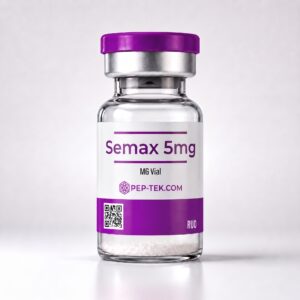
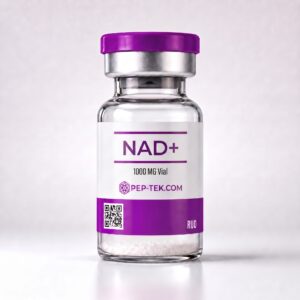
Available from PepTek
Semax and NAD+ represent two distinct molecular approaches studied in cognitive research. This comparison explores their structural differences, mechanisms, and research applications.
In the landscape of semax vs NAD+ cognitive research, two fundamentally different molecular classes have attracted significant scientific attention. Semax, a synthetic heptapeptide derived from the adrenocorticotropic hormone (ACTH) fragment, and NAD+ (nicotinamide adenine dinucleotide), a ubiquitous cellular coenzyme, represent contrasting biochemical strategies for studying neurological function, energy metabolism, and neuroprotection in preclinical models. Understanding their structural differences, distinct mechanisms of action, and research applications provides a useful framework for investigators designing studies in this space.
Semax carries the amino acid sequence Met-Glu-His-Phe-Pro-Gly-Pro, representing a fragment of the ACTH(4–10) sequence with a C-terminal Pro-Gly-Pro extension added to improve metabolic stability. This modification distinguishes Semax from its parent peptide and confers resistance to enzymatic degradation, extending its biological half-life in experimental models [Ashmarin et al., 1997]. As a neuropeptide analog, Semax interacts with specific receptor systems in the central nervous system, making it of interest in neuroscience research. Researchers exploring its molecular profile in greater depth can consult the Semax: ACTH-Derived Neuropeptide Research Profile for a detailed structural and mechanistic overview.
NAD+ is a dinucleotide composed of adenine, two phosphate groups, ribose, and nicotinamide. Unlike peptides, NAD+ is not a signaling molecule in the traditional sense but functions as an essential electron carrier in oxidation-reduction reactions and a substrate for enzymes including sirtuins, PARPs (poly ADP-ribose polymerases), and CD38. Its molecular weight is approximately 663 Da, compared to Semax’s roughly 887 Da. NAD+ is present in virtually every cell in living organisms and declines measurably with age in animal models, a feature that has driven substantial interest in its role in metabolic and neurological research [Gomes et al., 2013]. Researchers can explore NAD+’s broader biochemical roles in the NAD+: Coenzyme Research Profile and Cellular Metabolism Studies article.
Preclinical research suggests that Semax exerts effects on the central nervous system primarily through modulation of brain-derived neurotrophic factor (BDNF) expression and related neurotrophin signaling cascades. Animal model studies indicate that Semax administration is associated with upregulation of BDNF and its receptor TrkB in hippocampal and cortical regions, areas associated with learning and memory consolidation [Dolotov et al., 2006]. Researchers have also observed that Semax appears to modulate the serotonergic and dopaminergic systems in rodent models, contributing to its profile as a subject of interest in neuroprotection and cognitive research. Additionally, in vitro studies suggest that Semax may attenuate oxidative stress in neuronal cell lines, a property that intersects conceptually with research on antioxidant molecules such as those reviewed in the Glutathione: Tripeptide Antioxidant Research and Redox Signaling overview.
It is also worth noting that Semax shares structural lineage with melanocortin system peptides, which have been explored in the context of receptor binding studies. Researchers comparing peptide systems in this space may find the Selank: Synthetic Anxiolytic Peptide Research Overview a valuable parallel reference, as Selank represents another synthetic neuropeptide with central nervous system research applications.
In the context of semax vs NAD+ cognitive research, NAD+’s mechanism is fundamentally metabolic rather than receptor-mediated. NAD+ serves as an essential cofactor in the mitochondrial electron transport chain, facilitating ATP production through oxidative phosphorylation. In neuronal cells, which have exceptionally high energy demands, NAD+ availability is considered a critical determinant of mitochondrial function and cellular resilience [Gomes et al., 2013].
Beyond its role in bioenergetics, NAD+ acts as a substrate for sirtuin deacylases (SIRT1–SIRT7), which regulate gene expression, mitochondrial biogenesis, and cellular stress responses. PARP enzymes, which consume NAD+ during DNA repair, represent another key axis of NAD+ biology, particularly relevant in models of genotoxic stress and neurodegeneration. Research in animal models has associated NAD+ replenishment with improvements in mitochondrial integrity and markers of neuronal health, though these findings remain strictly within the preclinical domain [Yoshino et al., 2018].
When examining semax vs NAD+ cognitive research from an experimental design perspective, the two compounds are typically applied to distinct but sometimes overlapping research questions. Semax is most frequently studied in acute neurological injury models, including ischemia-reperfusion paradigms and models of oxidative neuronal damage, where its neurotrophic and neuroprotective properties are of primary interest. Animal model studies indicate that Semax may reduce infarct volume and preserve neurological function in rodent stroke models [Ashmarin et al., 1997].
NAD+ research, by contrast, is more frequently situated within aging biology, metabolic dysfunction, and chronic neurodegeneration models. Investigators studying age-related cognitive decline in rodent models have used NAD+ precursors such as NMN and NR to assess whether restoring NAD+ levels influences spatial memory tasks, hippocampal synaptic plasticity, and markers of neuroinflammation. The metabolic breadth of NAD+ research means it also intersects substantially with liver, muscle, and cardiovascular biology, distinguishing it from the more CNS-focused literature on Semax.
For researchers navigating semax vs NAD+ cognitive research for experimental design purposes, the choice between these compounds depends heavily on the specific biological question being asked. Studies focused on acute neuroprotection, BDNF signaling, or melanocortin-adjacent receptor systems will find Semax a more directly applicable research tool. Studies examining cellular energy metabolism, sirtuin biology, epigenetic regulation, or the systemic consequences of aging-related NAD+ depletion will find NAD+ supplementation models more relevant.
It is also important to recognize that these compounds are not mutually exclusive in research design. Some investigators have proposed that energy metabolism deficits and neurotrophic signaling deficits may interact in neurological disease models, suggesting that parallel or sequential studies using both compound classes could yield mechanistically informative data. The growing sophistication of semax vs NAD+ cognitive research reflects a broader trend toward multi-pathway analyses in neuroscience.
The comparison presented here is intended strictly for scientific research and educational purposes. Both Semax and NAD+ are research compounds supplied by PepTek for use in controlled laboratory settings only. Neither compound has been approved for human or animal therapeutic use by any regulatory authority in the context described herein. All findings referenced in this article are derived from preclinical studies, in vitro experiments, or animal models and should not be interpreted as evidence of clinical efficacy or safety in humans.
Researchers are advised to consult peer-reviewed literature, institutional review protocols, and applicable regulatory frameworks before conducting any experiments involving these or related compounds. PepTek supplies these materials exclusively for legitimate scientific investigation. Nothing in this article constitutes medical advice, dosing guidance, or a therapeutic recommendation of any kind.
This article is for research purposes only. PepTek compounds are not intended for human or animal consumption.