Available from PepTek
GHRP-6 vs tesamorelin GH research reveals two distinct mechanistic pathways for stimulating growth hormone release, each suited to different experimental models and research objectives.
Within the landscape of growth hormone (GH) secretagogue research, few comparisons are as instructive as GHRP-6 vs tesamorelin GH research. These two peptides stimulate GH release through fundamentally different receptor systems, exhibit distinct pharmacokinetic profiles, and have been studied in divergent preclinical and clinical contexts. Understanding these differences allows researchers to select the most appropriate compound for a given experimental model. This article provides a structured comparison of GHRP-6 and tesamorelin, covering molecular structure, receptor pharmacology, downstream signaling, and observed effects in published research.
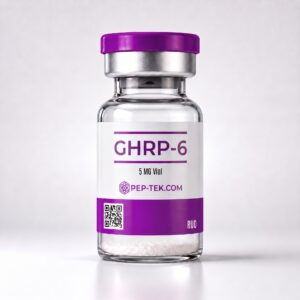
GHRP-6 (Growth Hormone-Releasing Peptide-6) is a synthetic, six-amino-acid peptide with the sequence His-D-Trp-Ala-Trp-D-Phe-Lys-NH₂. Originally derived from met-enkephalin, GHRP-6 was developed as a non-natural ligand for what was later identified as the ghrelin receptor (GHS-R1a). Its compact hexapeptide structure confers relative resistance to enzymatic degradation compared to endogenous peptides, though its half-life in solution remains limited without modification. The D-amino acid substitutions at positions 2 and 5 are critical for receptor binding affinity and metabolic stability [Bowers et al., 1984].
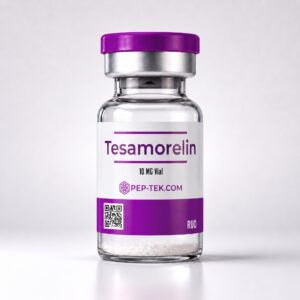
Tesamorelin is a synthetic analogue of endogenous growth hormone-releasing hormone (GHRH), consisting of the full 44-amino-acid sequence of human GHRH(1–44) conjugated to a trans-2-hexenoic acid moiety at the N-terminus. This modification substantially improves plasma stability relative to native GHRH, which is rapidly cleaved by dipeptidyl peptidase IV (DPP-IV). The structural integrity of the full GHRH sequence means tesamorelin retains authentic binding geometry at the GHRH receptor (GHRHR), a class B G-protein-coupled receptor. For a deeper exploration of tesamorelin’s pharmacological profile, researchers may consult PepTek’s dedicated article on Tesamorelin: GHRH Analogue Research Profile and Studied Effects.
GHRP-6 acts as a synthetic agonist at the growth hormone secretagogue receptor type 1a (GHS-R1a), the cognate receptor for ghrelin. Activation of GHS-R1a in somatotroph cells of the anterior pituitary triggers a Gq/11-mediated signaling cascade, leading to phospholipase C (PLC) activation, inositol trisphosphate (IP₃) generation, and intracellular calcium mobilization. This calcium flux drives GH exocytosis. Notably, GHRP-6 also acts at the hypothalamic level by stimulating GHRH release and suppressing somatostatin tone, creating an amplified pituitary GH pulse [Howard et al., 1996].
Beyond GH secretion, GHS-R1a is expressed in numerous peripheral tissues, including the heart, pancreas, and central nervous system. Preclinical studies have documented GHRP-6’s influence on appetite regulation, gastric motility, and cytoprotective pathways — observations distinct from its GH-releasing activity [Kojima et al., 1999]. Researchers examining GHRP compounds with a focus on selectivity may also find value in reviewing the Ipamorelin: Selective GHRP Research Profile, which contrasts GHRP-6’s broad receptor engagement with ipamorelin’s more targeted action.
Tesamorelin binds exclusively to the GHRH receptor, a Gs-coupled GPCR expressed predominantly on pituitary somatotrophs. Receptor activation stimulates adenylyl cyclase, elevates cyclic AMP (cAMP), and activates protein kinase A (PKA), culminating in voltage-gated calcium channel opening and GH secretion. Because tesamorelin follows the same physiological pathway as endogenous GHRH, the resultant GH pulses tend to preserve the pulsatile, feedback-regulated architecture of the somatotropic axis. Somatostatin-mediated inhibition remains intact, providing an intrinsic regulatory ceiling on GH release [Falutz et al., 2007].
This mechanistic fidelity to endogenous signaling is a primary reason researchers studying physiologically relevant GH secretion patterns often favor tesamorelin-based models. The intact feedback loop distinguishes tesamorelin from direct GH administration and from compounds that bypass hypothalamic regulation entirely.
In the context of GHRP-6 vs tesamorelin GH research, pharmacokinetic differences are experimentally significant. GHRP-6 has a reported plasma half-life of approximately 15–60 minutes in animal models, depending on the matrix and species. Its small size allows rapid tissue penetration but also rapid clearance.
Tesamorelin’s N-terminal trans-2-hexenoic acid modification blocks DPP-IV cleavage, extending its functional half-life to approximately 26–38 minutes in human pharmacokinetic studies — notably longer than unmodified GHRH(1–44), which is cleaved within minutes. This stabilization is central to tesamorelin’s utility as a research tool in longer-duration experimental paradigms [Stanley et al., 2011].
Both peptides require careful storage conditions; researchers working with structurally complex peptides may find relevant context in PepTek’s coverage of synergistic GH secretagogue combinations, specifically the CJC-1295 + Ipamorelin Blend: Research Overview of Synergistic Mechanisms, which examines how pharmacokinetic complementarity can shape experimental design.
Animal model studies with GHRP-6 have documented robust, dose-dependent GH secretion, with peak plasma GH concentrations observed within 15–30 minutes of administration in rodent models. Researchers have also noted GHRP-6’s influence on IGF-1 axis activity downstream of GH release. Separate lines of investigation have explored GHRP-6’s cardioprotective signaling properties in ischemia-reperfusion injury models, effects attributed to GHS-R1a expression in cardiac tissue rather than GH secretion per se [Bowers, 1998]. These pluripotent actions make GHRP-6 a compound of interest across multiple research domains simultaneously.
Tesamorelin has been extensively studied in models examining visceral adiposity, metabolic regulation, and GH-IGF-1 axis dynamics. Controlled research has demonstrated that tesamorelin administration in relevant animal and human study populations produces significant, sustained increases in IGF-1 levels consistent with enhanced GH pulsatility [Falutz et al., 2007]. Researchers have also characterized tesamorelin’s effects on lipid metabolism parameters in controlled settings. The compound’s specificity for the GHRHR — without the peripheral GHS-R1a activity associated with GHRP-6 — makes it preferable when investigators wish to isolate the GHRH-GH axis without confounding ghrelin pathway effects.
When navigating GHRP-6 vs tesamorelin GH research decisions, investigators typically consider several experimental variables:
The divergence in receptor systems also has implications for researchers studying the broader neuroendocrine environment. Investigations involving peptidergic compounds acting on CNS pathways — such as those reviewed in PepTek’s article on Semax: ACTH-Derived Neuropeptide Research Profile — highlight how receptor selectivity shapes the interpretability of experimental outcomes across neuroendocrine axes.
Both GHRP-6 and tesamorelin exert downstream effects that intersect with cellular metabolism through GH-stimulated IGF-1 production, which in turn influences glucose uptake, lipolysis, and protein synthesis in model systems. Researchers examining metabolic interplay may find comparative value in reviewing related coenzyme and antioxidant research; PepTek’s article on NAD+: Coenzyme Research Profile and Cellular Metabolism Studies provides useful context on how upstream signaling molecules modulate cellular bioenergetics, a pathway relevant to interpreting GH secretagogue data in metabolic research models.
In the broader context of GHRP-6 vs tesamorelin GH research, neither compound should be viewed in isolation. The somatotropic axis interfaces with multiple regulatory networks, and experimental design must account for these interactions when drawing mechanistic conclusions.
The comparative analysis of GHRP-6 vs tesamorelin GH research illustrates how subtle structural differences — a six-residue synthetic hexapeptide versus a stabilized 44-residue GHRH analogue — translate into meaningfully distinct receptor pharmacologies, kinetic profiles, and experimental utilities. GHRP-6’s GHS-R1a agonism offers researchers access to ghrelin pathway biology alongside GH secretagogue effects, while tesamorelin’s GHRHR specificity provides a physiologically coherent model for studying GHRH-GH axis dynamics with intact feedback regulation. Selecting between these compounds requires careful alignment of mechanistic targets with experimental objectives.
Research Use Disclaimer: All information presented in this article is intended strictly for scientific research and educational purposes. GHRP-6 and tesamorelin, as described herein, are research compounds supplied for use in controlled laboratory and preclinical settings only. Neither compound is approved, intended, or suitable for human or animal consumption, self-administration, or therapeutic use outside of appropriately regulated clinical trial contexts. No content in this article constitutes medical advice, dosing guidance, or a health benefit claim. PepTek supplies these compounds exclusively to qualified researchers for in vitro and appropriately supervised in vivo research applications.