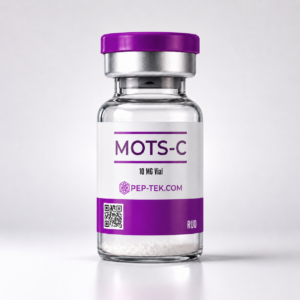
Available from PepTek
MOTS-c is a mitochondrial-derived peptide studied for its role in metabolic regulation, with research indicating effects on insulin sensitivity, AMPK activation, and glucose uptake in preclinical models.
MOTS-c (Mitochondrial Open Reading Frame of the Twelve S rRNA-c) is a 16-amino acid peptide encoded within the mitochondrial genome, specifically within the 12S ribosomal RNA gene. Since its initial characterization in 2015, MOTS-c has attracted considerable scientific interest as a mitochondria-derived signaling molecule — or “mitokine” — with notable metabolic properties. A growing body of preclinical research has investigated how MOTS-c influences cellular energy homeostasis, particularly in the context of MOTS-C insulin sensitivity research studies examining glucose metabolism and AMPK-dependent signaling pathways.
The discovery that small open reading frames within mitochondrial DNA encode biologically active peptides has opened a new chapter in metabolic biology. MOTS-c, along with humanin and the SHLP family of peptides, represents a class of mitochondrial-derived peptides (MDPs) that appear to act as intercellular messengers, influencing processes such as insulin signaling, oxidative stress regulation, and cellular senescence.
MOTS-c is of particular interest because researchers have observed that it can translocate from mitochondria to the nucleus in response to metabolic stress, where it regulates gene expression through interaction with the antioxidant response element (ARE) pathway. This dual role — as both a cytoplasmic and nuclear signaling agent — distinguishes MOTS-c from many other small peptides under investigation. Its relevance to redox biology draws conceptual parallels to research on molecules such as glutathione as a tripeptide antioxidant and redox signaling molecule, where cellular oxidative balance plays a central role in metabolic outcomes.
The landmark study by Lee and colleagues, published in Cell Metabolism in 2015, established much of the foundational understanding of MOTS-c biology [Lee et al., 2015]. Using both in vitro cell culture models and in vivo mouse models, the research team demonstrated that exogenous administration of synthetic MOTS-c to diet-induced obese mice produced significant improvements in insulin sensitivity, as measured by insulin tolerance tests and glucose tolerance tests.
This study positioned MOTS-c as a potentially significant factor in the biology of metabolic disease, prompting further investigation into the molecular architecture of its insulin-sensitizing properties.
A 2019 study by Kim and colleagues examined the relationship between physical exercise and circulating MOTS-c levels [Kim et al., 2019]. Researchers found that acute resistance exercise in human subjects significantly elevated plasma MOTS-c concentrations, and that these elevations correlated with post-exercise improvements in insulin sensitivity markers. This finding suggested that MOTS-c may serve as an exercise-induced mitokine, partly mediating the well-established metabolic benefits of physical activity at a molecular level.
The intersection of mitochondrial function, NAD+ metabolism, and energy sensing is worth noting here. Research on NAD+ as a coenzyme in cellular metabolism studies highlights how mitochondrial redox state directly influences AMPK signaling — the same pathway MOTS-c appears to engage — suggesting these systems may work in concert under physiological conditions.
Reynolds and colleagues published observations in 2021 indicating that circulating MOTS-c levels decline with age in both human subjects and rodent models [Reynolds et al., 2021]. Their analysis of older adult cohorts revealed an inverse correlation between MOTS-c plasma concentrations and markers of insulin resistance, including HOMA-IR scores. Animal model studies further indicated that restoring MOTS-c levels in aged mice improved glucose homeostasis, reduced systemic inflammation markers, and partially reversed age-associated metabolic dysfunction.
These findings are particularly compelling in the broader context of MOTS-C insulin sensitivity research studies, as they connect the peptide’s activity to the known phenomenon of age-associated metabolic decline — an area of intense current investigation across multiple research disciplines.
Multiple independent research groups have confirmed that skeletal muscle represents the primary site of MOTS-c metabolic action. In vitro studies using C2C12 myotubes — a standard skeletal muscle cell model — consistently demonstrate that MOTS-c treatment enhances glucose uptake in an AMPK-dependent manner, with some studies reporting increased GLUT4 translocation to the cell membrane [Lu et al., 2019]. This mechanism is particularly relevant because impaired GLUT4 translocation in skeletal muscle is a hallmark of insulin-resistant states in preclinical models.
The selectivity of MOTS-c for skeletal muscle tissue differentiates it mechanistically from other metabolic research compounds. For comparison, researchers studying incretin-based compounds such as those profiled in the semaglutide GLP-1 receptor agonist research and tirzepatide GLP-1/GIP dual agonist research profile note that those compounds act primarily through pancreatic and hypothalamic mechanisms, whereas MOTS-c’s primary metabolic action appears peripherally localized to muscle tissue.
Based on the accumulated body of MOTS-C insulin sensitivity research studies, the proposed molecular cascade observed in preclinical models can be summarized as follows:
While preclinical data supporting the role of MOTS-c in metabolic regulation are compelling, researchers have identified several important limitations and unanswered questions:
These open questions underscore why ongoing MOTS-C insulin sensitivity research studies in controlled laboratory settings remain scientifically important and why MOTS-c continues to be a subject of active preclinical investigation.
The studies summarized here represent a focused body of preclinical and early observational research into MOTS-c as a mitochondrial-derived signaling peptide. The data emerging from MOTS-C insulin sensitivity research studies in cell culture and animal models provide a scientific foundation for understanding how mitochondrial biology interfaces with glucose metabolism at the molecular level.
Disclaimer: All information presented in this article is intended strictly for research and educational purposes. MOTS-c, as discussed herein, is a research compound supplied by PepTek for use in laboratory settings only. Nothing in this article constitutes medical advice, and no information provided should be interpreted as guidance for human or animal administration. MOTS-c is not approved by the FDA or any regulatory authority for therapeutic use. Researchers working with this compound should adhere to all applicable institutional, ethical, and regulatory standards governing the use of research peptides in controlled laboratory environments.