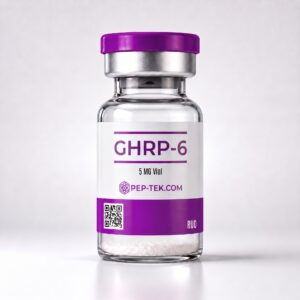
Available from PepTek
GHRP-6 ghrelin receptor research studies reveal how this synthetic hexapeptide binds the GHS-R1a receptor to stimulate GH secretion and modulate downstream signaling pathways in preclinical models.
Growth Hormone Releasing Peptide-6 (GHRP-6) is a synthetic hexapeptide that has been extensively characterized in preclinical and in vitro research for its capacity to bind the growth hormone secretagogue receptor type 1a (GHS-R1a), commonly referred to as the ghrelin receptor. A substantial body of published research has explored the molecular pharmacology of GHRP-6 ghrelin receptor research studies, establishing foundational knowledge about receptor binding kinetics, second messenger cascades, and downstream biological signals observed in controlled laboratory settings. This article summarizes key findings from landmark studies examining these mechanisms.
The GHS-R1a receptor is a G protein-coupled receptor (GPCR) predominantly expressed in the hypothalamus and pituitary gland, where it serves as the primary receptor for the endogenous hormone ghrelin. GHRP-6, a synthetic peptide with the amino acid sequence His-D-Trp-Ala-Trp-D-Phe-Lys-NH₂, was among the earliest compounds demonstrated to act as a functional GHS-R1a agonist in research models prior to the identification of ghrelin itself [Bowers et al., 1993].
The hexapeptide structure of GHRP-6 was specifically engineered to resist enzymatic degradation while retaining high-affinity binding to GHS-R1a. Researchers have noted that its D-amino acid substitutions at positions 2 and 5 are critical for conformational stability and receptor selectivity. Comparative receptor profiling in the literature has distinguished GHRP-6 from related secretagogues such as those reviewed in the Ipamorelin selective GHRP research profile, which highlights structural differences that confer varying degrees of receptor selectivity and downstream signaling profiles.
One of the foundational investigations into GHRP-6 ghrelin receptor research studies was conducted by Bowers and colleagues, who demonstrated that GHRP-6 stimulated growth hormone release in rat pituitary cell cultures through a receptor-mediated mechanism distinct from GHRH pathways [Bowers et al., 1993]. Radioligand binding assays using ¹²⁵I-labeled GHRP-6 revealed high-affinity binding sites on pituitary somatotrophs with Kd values in the low nanomolar range, indicating potent receptor engagement under in vitro conditions.
Subsequent studies confirmed that GHS-R1a coupling occurs primarily through Gαq/11 proteins, leading to phospholipase C (PLC) activation, inositol triphosphate (IP₃) generation, and intracellular calcium mobilization. This calcium influx was identified as the primary trigger for growth hormone exocytosis from somatotroph cells in pituitary slice preparations [Howard et al., 1996].
Research by Popovic and colleagues systematically examined the interaction between GHRP-6 and endogenous GHRH at the hypothalamic level, reporting that GHRP-6 not only acts directly at pituitary GHS-R1a receptors but also stimulates hypothalamic GHRH release, creating a synergistic amplification of GH pulse amplitude in rodent models [Popovic et al., 1995]. This dual-site action has been a consistent finding across GHRP-6 ghrelin receptor research studies and helps explain the supraadditive GH responses observed when GHRP-6 is combined with GHRH analogues in animal models. Researchers interested in the broader class of GHRH analogues may find relevant mechanistic parallels in the Tesamorelin GHRH analogue research profile, which documents how GHRH receptor activation complements secretagogue activity.
Beyond pituitary biology, GHRP-6 has been studied for GHS-R1a-dependent and independent effects in peripheral tissues. A notable series of experiments by Granado and colleagues identified anti-inflammatory signaling in macrophage cell lines, with GHRP-6 treatment observed to suppress NF-κB pathway activation and reduce pro-inflammatory cytokine expression in lipopolysaccharide-challenged cells [Granado et al., 2011]. These findings extended the research interest in GHRP-6 beyond GH secretagogue activity and into the domain of immunomodulatory receptor pharmacology.
Cardiac and hepatic tissue preparations have also been studied in rodent models, where researchers observed cytoprotective responses following ischemic challenge. The proposed mechanism involved GHS-R1a-mediated activation of PI3K/Akt and ERK1/2 survival pathways, though investigators emphasized that these observations were confined to animal model contexts and do not establish clinical applicability [Frascarelli et al., 2003]. The investigation of peptide-mediated cytoprotective signaling is a recurring theme in research on bioactive peptides; for instance, researchers examining copper peptide signaling pathways will find complementary cellular survival pathway data in the GHK-Cu copper peptide research profile.
A critical area of GHRP-6 ghrelin receptor research studies has been comparative receptor selectivity profiling. Unlike more selective compounds, GHRP-6 has been shown to engage secondary receptors including CD36 in specific tissue preparations, a finding that may partially explain peripheral effects observed in non-pituitary tissue models. Radioligand competition assays have further confirmed that GHRP-6 competes directly with ghrelin for GHS-R1a occupancy with high affinity, validating its classification as a full GHS-R1a agonist in vitro.
Research comparing GHRP-6 to the blended secretagogue approach has also been documented; readers may reference the CJC-1295 and Ipamorelin blend synergistic mechanisms overview for context on how dual-receptor targeting strategies in research models are structured relative to single-agent GHRP approaches.
Across the reviewed body of GHRP-6 ghrelin receptor research studies, the following intracellular signaling events have been consistently documented in cell and animal models:
This multi-pathway signal transduction profile has made GHRP-6 a valuable research tool for investigating GHS-R1a biology independently of endogenous ghrelin variability in experimental systems.
Crystallographic and molecular docking studies have contributed to understanding how GHRP-6 occupies the orthosteric binding pocket of GHS-R1a. The D-Trp² residue of GHRP-6 has been identified through mutagenesis experiments as critical for high-affinity receptor engagement, interacting with transmembrane domains III and VI of GHS-R1a. These structural insights have informed the rational design of subsequent generations of synthetic secretagogues studied across multiple research programs. The broader context of GPCR-targeted peptide research is also illustrated in studies of other receptor systems, such as those covered in the Melanotan II melanocortin receptor agonist research profile, where distinct GPCR binding architectures are characterized.
The studies summarized here represent findings from in vitro cell culture systems, radioligand binding assays, and rodent animal models only. GHRP-6 ghrelin receptor research studies have collectively advanced the scientific understanding of GHS-R1a pharmacology and synthetic secretagogue design principles. All data referenced in this article derive from controlled preclinical research environments.
Research Use Disclaimer: GHRP-6 is supplied by PepTek exclusively as a research compound for use in qualified laboratory settings. It is not approved for human or animal consumption, is not intended for therapeutic, diagnostic, or preventative applications, and has not been evaluated by the FDA or any equivalent regulatory authority for clinical use. Nothing in this article constitutes medical advice, dosing guidance, or a claim of therapeutic efficacy. Researchers should consult all applicable institutional and regulatory guidelines prior to conducting studies involving this compound.