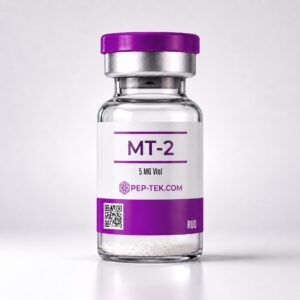
Available from PepTek
Research on melanotan II melanogenesis studies reveals how MT-2 activates MC1R to stimulate melanin synthesis in preclinical models, offering insights into pigmentation biology.
Melanotan II melanogenesis research studies have become an important area of investigation for scientists exploring the molecular mechanisms underlying skin pigmentation. Melanotan II (MT-2), a synthetic cyclic heptapeptide analogue of alpha-melanocyte-stimulating hormone (α-MSH), has attracted considerable attention in preclinical research due to its potent agonist activity at melanocortin receptors — particularly the melanocortin-1 receptor (MC1R). This article summarizes key findings from published research examining how MT-2 interacts with MC1R to drive melanogenesis at the cellular and molecular level.
For a broader overview of MT-2’s receptor pharmacology and general research profile, researchers may consult the Melanotan II (MT-2): Melanocortin Receptor Agonist Research Profile on PepTek’s research library.
MC1R is a G protein-coupled receptor (GPCR) predominantly expressed on the surface of melanocytes. Upon ligand binding, MC1R activates adenylyl cyclase, leading to an increase in intracellular cyclic adenosine monophosphate (cAMP). Elevated cAMP activates protein kinase A (PKA), which in turn phosphorylates the transcription factor CREB (cAMP response element-binding protein). CREB then upregulates MITF (microphthalmia-associated transcription factor), the master regulator of melanocyte differentiation and melanin biosynthesis [Cui et al., 2007].
This signaling cascade ultimately drives the transcription of key melanogenic enzymes including tyrosinase (TYR), tyrosinase-related protein 1 (TYRP1), and dopachrome tautomerase (DCT/TYRP2), each of which plays a distinct role in the production of eumelanin and pheomelanin within melanosomes.
One of the foundational areas of melanotan II melanogenesis research studies involves in vitro characterization of MT-2’s binding affinity and functional potency at MC1R. Landmark binding studies demonstrated that MT-2 exhibits markedly higher receptor binding affinity compared to the endogenous ligand α-MSH, with reported IC50 values in the low nanomolar range [Haskell-Luevano et al., 1996]. Researchers observed that this enhanced potency is attributed to the cyclic structure of MT-2, which constrains the peptide in a bioactive conformation that optimizes receptor contact.
Subsequent cell-based assays using B16-F10 murine melanoma cells — a widely used model for melanogenesis research — confirmed that MT-2 dose-dependently elevated intracellular cAMP levels and stimulated melanin output. These studies provided early mechanistic evidence that MT-2 functions as a full agonist at MC1R, effectively mimicking and surpassing the activity of endogenous melanocortins in vitro.
Further melanotan II melanogenesis research studies have focused specifically on MT-2’s capacity to upregulate tyrosinase — the rate-limiting enzyme in melanin biosynthesis. Researchers using immortalized human melanocyte cell lines and murine melanoma cell cultures reported that MT-2 treatment significantly increased both tyrosinase mRNA expression and enzymatic activity, as measured by DOPA oxidase assays [Loir et al., 1997].
Quantitative melanin content assays in these models demonstrated proportional increases in total melanin production correlating with MC1R activation kinetics. Importantly, researchers noted that eumelanin production appeared preferentially stimulated over pheomelanin synthesis under MT-2 treatment conditions, a distinction with important implications for understanding photoprotective pigmentation biology at the molecular level.
Research has examined how MT-2-driven MC1R activation specifically modulates MITF at the transcriptional and post-translational levels. Studies in B16 melanoma cells and primary human melanocyte cultures demonstrated that MT-2 treatment resulted in rapid nuclear accumulation of MITF and increased MITF-dependent gene transcription [Busca and Ballotti, 2000]. This work helped establish the mechanistic link between MC1R agonism and downstream enzymatic upregulation, situating MITF as the central transcriptional node through which MT-2 exerts its melanogenic effects.
Of note, researchers also observed interactions between the cAMP/PKA pathway and parallel MAPK signaling routes, suggesting that MT-2’s effects on MITF stability involve cross-talk between multiple intracellular signaling networks. This complexity underscores the value of continued in vitro and in vivo research to fully delineate MT-2’s molecular mechanisms.
Beyond cell culture systems, melanotan II melanogenesis research studies have been extended into animal models to examine pigmentation outcomes in intact biological systems. Early murine studies conducted by Hadley and colleagues demonstrated that systemic administration of MT-2 in rodents produced measurable darkening of fur pigmentation, corroborating the in vitro receptor pharmacology data [Hadley et al., 1998]. These preclinical observations were instrumental in establishing MT-2 as a research tool for studying MC1R-mediated pigmentation biology in vivo.
Researchers using MC1R-deficient (extension locus) mouse models provided additional mechanistic clarity, showing that MT-2-induced pigmentation responses were substantially attenuated in the absence of functional MC1R, confirming that MC1R is the primary mediator of MT-2’s melanogenic activity rather than off-target effects at other melanocortin receptor subtypes [García-Borrón et al., 2005].
An emerging area within melanotan II melanogenesis research studies involves the intersection of melanin biosynthesis and cellular redox status. The melanogenesis pathway itself generates reactive oxygen species (ROS) as enzymatic byproducts, particularly during the oxidation of tyrosine to DOPA and subsequent intermediates. Research has highlighted that the cellular antioxidant environment can modulate the efficiency and output of the melanogenesis cascade.
In this context, it is scientifically interesting to note that compounds influencing cellular redox balance — such as those examined in Glutathione: Tripeptide Antioxidant Research and Redox Signaling — may interact with melanogenesis pathways, as glutathione availability is known to influence the eumelanin-to-pheomelanin ratio in melanocytes. Similarly, research on energy metabolism and cellular signaling — such as that reviewed in NAD+: Coenzyme Research Profile and Cellular Metabolism Studies — provides important context for understanding the metabolic demands of active melanocyte function.
A key consideration in interpreting melanotan II melanogenesis research studies is MT-2’s lack of selectivity across the melanocortin receptor family. MT-2 binds with high affinity not only to MC1R but also to MC3R, MC4R, and MC5R, each of which mediates distinct physiological functions in preclinical models. This broad receptor engagement means that researchers must carefully design experimental systems — such as using MC1R-selective cell lines or receptor knockout models — to isolate melanogenesis-specific effects from other melanocortin signaling outcomes.
The development of more selective MC1R agonists based on MT-2’s pharmacophore represents an active area of medicinal chemistry research, with the goal of producing research tools capable of dissecting MC1R-specific contributions to melanogenesis without confounding signals from other receptor subtypes. MT-2 itself, however, remains a valuable and widely used research standard for studies of melanocortin receptor biology.
Researchers studying other peptide signaling systems with relevance to receptor pharmacology may also find value in reviewing the GHK-Cu: Copper Peptide Research Profile and Signaling Pathways, which examines a structurally distinct peptide system with documented effects on gene expression and cellular signaling cascades.
The body of melanotan II melanogenesis research studies reviewed here represents preclinical findings derived exclusively from in vitro cell culture systems and animal models. These studies are conducted in controlled laboratory environments for the purpose of advancing scientific understanding of melanocortin receptor biology, melanogenesis signaling pathways, and pigmentation mechanisms at the molecular level.
MT-2 and all related research compounds discussed in this article are intended exclusively for laboratory research purposes. They are not approved for human or veterinary use, are not intended for consumption or administration to any living subject, and should not be interpreted as having demonstrated safety or efficacy in humans. No content in this article constitutes medical advice, dosing guidance, or a therapeutic claim of any kind. Researchers are encouraged to consult the primary literature cited below and to conduct all investigations in accordance with applicable institutional and regulatory guidelines.
This article is provided for informational and scientific research purposes only by PepTek, a supplier of research compounds for laboratory use.