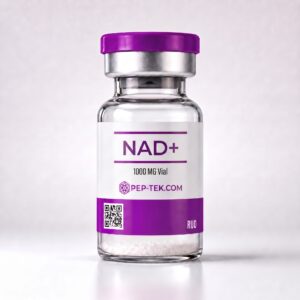
Available from PepTek
Preclinical research on NAD+ mitochondrial function reveals critical roles in energy metabolism, sirtuin activation, and oxidative stress regulation across multiple animal and in vitro model systems.
Nicotinamide adenine dinucleotide (NAD+) is a central coenzyme in cellular metabolism, functioning as an essential electron carrier in mitochondrial energy production and as a substrate for a broad class of regulatory enzymes. Over the past two decades, a growing body of preclinical literature has focused specifically on NAD+ mitochondrial function research, examining how NAD+ availability influences mitochondrial biogenesis, respiratory chain efficiency, and cellular stress responses. This article summarizes key findings from published preclinical studies that have shaped current scientific understanding of NAD+ biology at the mitochondrial level. For a broader overview of NAD+’s coenzyme properties and cellular metabolism roles, researchers may find the NAD+: Coenzyme Research Profile and Cellular Metabolism Studies article a useful companion resource.
Within mitochondria, NAD+ occupies a dual role: it accepts electrons during glycolysis and the tricarboxylic acid (TCA) cycle, becoming NADH, and it serves as a substrate for sirtuins—particularly SIRT1 and SIRT3—as well as for poly(ADP-ribose) polymerases (PARPs) and CD38. These enzymatic consumers of NAD+ link its availability directly to mitochondrial quality control, DNA repair signaling, and antioxidant defense. Researchers have noted that declining NAD+ pools in aged tissues are associated with measurable disruptions in mitochondrial membrane potential, reduced ATP output, and impaired mitophagy [Gomes et al., 2013].
This intersection between NAD+ status and mitochondrial integrity has made NAD+ mitochondrial function research one of the most active areas of preclinical aging biology. The coenzyme’s involvement in redox homeostasis also connects it mechanistically to other antioxidant systems—an area explored in detail in the Glutathione: Tripeptide Antioxidant Research and Redox Signaling article, which highlights the broader cellular context of oxidative balance.
One of the most frequently cited studies in NAD+ mitochondrial function research was published by Gomes and colleagues in Cell in 2013. Using aged mouse models, the research team demonstrated that a decline in nuclear NAD+ levels disrupts communication between the nucleus and mitochondria via a pathway involving SIRT1 and hypoxia-inducible factor 1-alpha (HIF-1α). When NAD+ precursors were administered to aged mice, researchers observed restoration of mitochondrial homeostasis markers, including improved electron transport chain complex activity and reduced mitochondrial fragmentation. The study concluded that NAD+ availability is a critical upstream regulator of the pseudo-hypoxic state observed in aging tissues [Gomes et al., 2013].
A 2012 study published in Cell Metabolism by Cantó and colleagues investigated the effects of elevated NAD+ on mitochondrial function in skeletal muscle of mice. The researchers found that increasing NAD+ bioavailability through nicotinamide riboside (NR) supplementation activated SIRT1 and SIRT3, leading to enhanced mitochondrial biogenesis, increased oxidative metabolism, and improved exercise performance in mouse models. Notably, SIRT3 activation within the mitochondrial matrix was associated with deacetylation of key metabolic enzymes, including isocitrate dehydrogenase 2 (IDH2), which plays a central role in TCA cycle flux [Cantó et al., 2012]. These findings reinforced the mechanistic link between cytosolic NAD+ pools and intramitochondrial regulatory networks.
Yoshino and colleagues published a landmark study in Cell Metabolism in 2011 examining the role of nicotinamide mononucleotide (NMN), a direct NAD+ precursor, in restoring mitochondrial function in mouse models of diet-induced obesity and age-associated metabolic decline. In these mouse models, researchers observed significant reductions in NAD+ levels in multiple tissues. Administration of NMN in these animal models was associated with normalization of NAD+ concentrations, increased SIRT1 activity, and improvements in mitochondrial oxygen consumption rates measured ex vivo. The study also documented changes in gene expression profiles consistent with enhanced mitochondrial biogenesis [Yoshino et al., 2011].
Beyond biogenesis, preclinical studies have examined how NAD+ governs mitochondrial quality control through regulation of autophagy and mitophagy—the selective degradation of damaged mitochondria. Research by Fang and colleagues published in Nature Communications in 2019 used Caenorhabditis elegans and mouse models to demonstrate that NAD+ repletion promoted mitophagy through a SIRT1/PINK1/Parkin-dependent pathway. In nematode models of mitochondrial disease, NAD+ precursor administration was associated with measurable increases in mitochondrial membrane potential and reductions in markers of oxidative stress [Fang et al., 2019]. These data suggest that NAD+ mitochondrial function research extends to the active clearance and recycling of dysfunctional organelles—a process critical to cellular longevity in model organisms.
A recurring theme across multiple in vitro and animal model studies is the relationship between NAD+ availability and reactive oxygen species (ROS) production at the mitochondrial level. When NAD+ pools are depleted, electron flow through Complexes I and III of the electron transport chain becomes less efficient, increasing superoxide generation. In vitro studies in neuronal cell lines and cardiomyocyte models have indicated that maintaining adequate NAD+ concentrations reduces mitochondrial ROS output under conditions of metabolic stress [Cantó et al., 2012]. This observation places NAD+ within the broader framework of mitochondrial antioxidant defense, complementing enzymatic systems that directly neutralize ROS.
The overlap between NAD+-driven mitochondrial protection and peptide-based cytoprotective signaling is an area of growing interest in preclinical research. For example, researchers studying tissue-protective peptides such as those profiled in the GHK-Cu: Copper Peptide Research Profile and Signaling Pathways article have similarly documented antioxidant and mitochondrial stabilization effects in cell culture models, reflecting broad scientific interest in non-pharmacological modulators of mitochondrial health.
Animal model studies in rodent models of cardiac ischemia-reperfusion injury have shown that elevated NAD+ levels prior to ischemic insult are associated with reduced mitochondrial permeability transition pore (mPTP) opening and decreased cardiomyocyte death. Researchers attribute this effect partly to SIRT3-mediated deacetylation of cyclophilin D, a key regulator of mPTP opening.
In neuronal cell culture systems, NAD+ depletion induced by genotoxic stress has been shown to precipitate mitochondrial membrane collapse and ATP crisis. Preclinical NAD+ mitochondrial function research in rodent models of neurodegeneration has documented that maintaining NAD+ availability preserves mitochondrial morphology and delays neuronal apoptosis in these experimental systems.
As detailed by Cantó and Yoshino in the studies summarized above, skeletal muscle and liver represent tissues particularly sensitive to changes in NAD+ status, with mitochondrial oxidative capacity closely tracking with intracellular NAD+/NADH ratios in animal models.
The preclinical studies summarized here collectively illustrate the central importance of NAD+ in regulating mitochondrial biogenesis, quality control, oxidative phosphorylation efficiency, and antioxidant defense across multiple model systems. NAD+ mitochondrial function research continues to generate significant interest in the fields of metabolic biology, aging science, and mitochondrial medicine.
Researchers seeking to explore NAD+ biology further in controlled laboratory settings may wish to reference the NAD+: Coenzyme Research Profile and Cellular Metabolism Studies article for additional mechanistic context, as well as the Glutathione: Tripeptide Antioxidant Research and Redox Signaling overview for related redox biology research.
Research Use Disclaimer: All compounds, findings, and data discussed in this article pertain exclusively to preclinical research conducted in cell culture and animal model systems. NAD+ and its precursors as discussed herein are intended for laboratory research purposes only. Nothing in this article constitutes medical advice, therapeutic guidance, or a suggestion that any compound described is safe or effective for use in humans or animals. PepTek supplies research-grade compounds strictly for qualified scientific research applications.