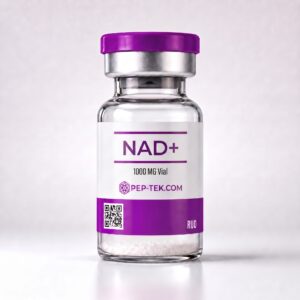
Available from PepTek
Research into NAD+ sirtuins aging studies reveals how declining NAD+ levels impair sirtuin-mediated cellular repair, mitochondrial function, and genomic stability in aged organisms.
Over the past two decades, a substantial body of preclinical and translational research has converged on a compelling hypothesis: the progressive decline in intracellular nicotinamide adenine dinucleotide (NAD+) concentrations is a foundational driver of the biological aging process. Central to this hypothesis is the family of NAD+-dependent deacylase enzymes known as sirtuins (SIRT1–SIRT7), which regulate a remarkable range of cellular maintenance programs—from DNA repair and mitochondrial biogenesis to inflammation suppression and stress response. Research into NAD+ sirtuins aging research studies has expanded dramatically, offering a detailed mechanistic portrait of how this coenzyme-enzyme axis operates and deteriorates with age.
For researchers interested in the broader biochemical profile of this coenzyme, the NAD+: Coenzyme Research Profile and Cellular Metabolism Studies article provides foundational context on NAD+’s biosynthetic pathways and metabolic roles.
Sirtuins are class III histone deacetylases that require NAD+ as an obligate co-substrate. Each catalytic cycle consumes one molecule of NAD+, yielding nicotinamide (NAM) and O-acetyl-ADP-ribose as byproducts. This stoichiometric dependence means that sirtuin activity is directly sensitive to cellular NAD+ flux—when NAD+ levels fall, sirtuin function is correspondingly impaired. Experimental models consistently demonstrate that tissue NAD+ concentrations decline by approximately 50% between young adulthood and middle age in rodents, with similar trends observed in human tissue samples [Camacho-Pereira et al., 2016].
SIRT1, the most extensively studied sirtuin, deacetylates key targets including p53, NF-κB, and PGC-1α, regulating apoptosis, inflammatory signaling, and mitochondrial biogenesis, respectively. SIRT3 localizes to the mitochondrial matrix and maintains the activity of enzymes involved in oxidative phosphorylation and reactive oxygen species (ROS) scavenging. SIRT6 operates primarily at the chromatin level, where it promotes DNA double-strand break repair and suppresses retrotransposon activity—a process increasingly implicated in inflammaging.
One of the foundational studies in NAD+ sirtuins aging research studies was published by Yoshino and colleagues in 2011, demonstrating that intraperitoneal administration of nicotinamide mononucleotide (NMN)—a direct NAD+ precursor—rapidly elevated hepatic and skeletal muscle NAD+ concentrations in aged mice. Crucially, this restoration correlated with significant increases in SIRT1 and SIRT3 activity, improved mitochondrial oxidative capacity, and enhanced insulin sensitivity [Yoshino et al., 2011]. The study was among the first to establish a causal link between NAD+ repletion and sirtuin-dependent metabolic improvement in an aged mammalian organism.
A landmark 2013 study by Gomes et al. in Cell identified a mechanism by which declining NAD+ in aged muscle cells disrupts SIRT1-mediated deacetylation of HIF-1α (hypoxia-inducible factor 1-alpha). Normally, SIRT1 keeps HIF-1α activity in check; when NAD+ drops, SIRT1 activity falls, HIF-1α becomes hyperactive, and the cell enters a state of pseudohypoxia—mimicking the gene expression pattern of oxygen deprivation even under normoxic conditions. This pseudohypoxic state suppresses mitochondrial electron transport chain subunit expression and disrupts the nuclear-mitochondrial communication essential for energy homeostasis [Gomes et al., 2013]. NMN administration in aged mice was shown to reverse these transcriptional signatures within just one week, providing a mechanistic rationale for NAD+ repletion strategies in aging research.
Zhang and colleagues demonstrated that NAD+ supplementation via NMN restored muscle stem cell (MuSC) function in aged mice through a SIRT1-dependent mechanism. In aged animals, reduced NAD+ impaired SIRT1’s ability to deacetylate and suppress NICD (Notch intracellular domain), which is required for MuSC self-renewal. Restoring NAD+ reactivated SIRT1-mediated NICD deacetylation, enhanced regenerative capacity of aged muscle, and extended median lifespan in treated cohorts [Zhang et al., 2016]. This study was notable for bridging NAD+ sirtuins aging research studies with stem cell biology—an emerging frontier in geroscience.
A comprehensive review by Bonkowski and Sinclair in Nature Reviews Molecular Cell Biology synthesized evidence across multiple sirtuin isoforms, cataloguing how each responds to NAD+ depletion during aging. The review highlighted SIRT6’s role in suppressing LINE-1 retrotransposon activity—a phenomenon that, when left unchecked in aged cells with low NAD+, generates cytosolic DNA fragments that trigger cGAS-STING innate immune activation and chronic sterile inflammation [Bonkowski and Sinclair, 2016]. This mechanistic thread connects NAD+ metabolism directly to the inflammaging hypothesis of aging, underscoring the broad regulatory importance of maintaining adequate NAD+ levels in research models.
The relationship between NAD+ levels and cellular redox status extends beyond sirtuin regulation. NAD+ serves as an electron carrier in glycolysis and the citric acid cycle, and its ratio relative to NADH (the reduced form) governs the thermodynamics of these core metabolic pathways. In aged tissues, this NAD+/NADH ratio shifts toward a more reduced state, impairing metabolic flexibility and increasing mitochondrial ROS production.
This redox dimension of aging research intersects with parallel investigations into endogenous antioxidant systems. Researchers studying oxidative stress in aging contexts may find complementary insights in the Glutathione: Tripeptide Antioxidant Research and Redox Signaling profile, which addresses how glutathione-mediated redox buffering interacts with mitochondrial health in cellular aging models.
SIRT3, localized to the mitochondrial matrix, has been specifically shown to deacetylate and activate key antioxidant enzymes including manganese superoxide dismutase (MnSOD) and isocitrate dehydrogenase 2 (IDH2). When NAD+ falls, SIRT3 activity is suppressed, these enzymes remain hyperacetylated and underactive, and mitochondrial ROS accumulate—a cascade that accelerates damage to mtDNA, lipid membranes, and electron transport chain complexes.
An important mechanistic consideration in NAD+ sirtuins aging research studies is the competition for NAD+ between sirtuins and poly(ADP-ribose) polymerases (PARPs). PARPs—particularly PARP1—are activated by DNA strand breaks and consume large quantities of NAD+ to synthesize poly(ADP-ribose) chains that recruit DNA repair machinery. In aged cells, accumulated genomic damage leads to chronic PARP1 hyperactivation, creating a futile cycle in which DNA damage depletes NAD+, NAD+ depletion impairs SIRT1-mediated DNA repair, and unresolved damage further activates PARP1. This vicious cycle has been proposed as a central amplifier of the aging phenotype and represents a compelling target for research intervention strategies aimed at restoring NAD+ homeostasis.
Beyond NMN, researchers have investigated nicotinamide riboside (NR) as an alternative NAD+ precursor with favorable tissue bioavailability profiles. A 2018 randomized, double-blind, placebo-controlled clinical trial by Martens et al. confirmed that oral NR supplementation elevated whole-blood NAD+ concentrations in healthy older adults and was associated with reductions in circulating inflammatory markers, though the study authors were careful to note that mechanistic conclusions regarding sirtuin activation in humans require further investigation [Martens et al., 2018].
Research into tissue-specific NAD+ dynamics—particularly in the brain, liver, and adipose tissue—continues to expand. The potential intersection of NAD+ biology with neuropeptide systems involved in cellular resilience is an active area of inquiry. Researchers examining neuronal energy metabolism may find relevant mechanistic parallels in the GHK-Cu: Copper Peptide Research Profile and Signaling Pathways article, which covers how redox-active peptide signaling influences gene expression programs related to cellular maintenance and longevity pathways.
Additionally, given that aging research frequently intersects with metabolic dysfunction, investigators working at the interface of NAD+ biology and energy homeostasis may find comparative value in reviewing receptor-level metabolic research, such as that summarized in the Tirzepatide: GLP-1/GIP Dual Agonist Research Profile, where sirtuin-adjacent pathways including AMPK and PGC-1α appear as downstream effectors of incretin signaling.
The study of NAD+ sirtuins aging research studies continues to mature, with ongoing work directed at understanding tissue-specific sirtuin isoform contributions, the role of NAD+ in epigenetic reprogramming, and the interaction between NAD+ metabolism and the senescence-associated secretory phenotype (SASP).
The studies summarized in this article represent findings from controlled preclinical experiments and early-phase human translational research. All data and mechanistic interpretations described herein were generated in laboratory or animal model settings, or in carefully monitored human research trial contexts conducted under institutional oversight.
Disclaimer: All information presented in this article is intended strictly for scientific research and educational purposes. NAD+ and related compounds discussed here are research reagents supplied by PepTek for use in authorized laboratory research only. Nothing in this article constitutes medical advice, therapeutic guidance, or endorsement of any compound for human or animal use outside of a properly supervised research setting. Researchers should consult all applicable institutional, regulatory, and ethical guidelines before conducting studies involving these compounds.