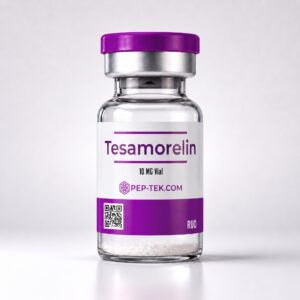
Available from PepTek
Tesamorelin visceral fat research studies demonstrate consistent reductions in visceral adipose tissue in controlled trials, offering researchers a valuable model for studying GHRH analogue effects on body composition.
Tesamorelin, a synthetic analogue of growth hormone-releasing hormone (GHRH), has attracted considerable scientific attention for its observed effects on visceral adipose tissue (VAT) accumulation in controlled research settings. A growing body of clinical and mechanistic study data positions tesamorelin visceral fat research studies among the most rigorously characterized investigations into GHRH analogue biology. This article summarizes key published studies, their methodologies, and their principal findings for researchers seeking a detailed overview of this compound’s studied mechanisms.
For a broader mechanistic profile of tesamorelin’s pharmacology, researchers may also consult our companion article, Tesamorelin: GHRH Analogue Research Profile and Studied Effects, which outlines receptor-binding characteristics and downstream signaling pathways in greater depth.
Visceral adipose tissue is a metabolically distinct fat depot located within the abdominal cavity, surrounding internal organs. Unlike subcutaneous fat, VAT is characterized by higher lipolytic activity, proximity to the portal circulation, and a distinct secretory profile of adipokines and inflammatory cytokines. These properties have made VAT a focus of metabolic research across numerous investigative contexts.
Growth hormone (GH) and its upstream regulator GHRH are known to influence adipose tissue metabolism, particularly lipolysis and lipid oxidation. Tesamorelin, by stimulating endogenous GH secretion through pituitary GHRH receptors, provides researchers with a tool to probe these relationships in a physiologically relevant manner. This mechanistic pathway distinguishes tesamorelin from direct GH administration and has been of particular interest in adipose tissue biology studies.
The most extensively cited tesamorelin visceral fat research studies are the phase III randomized, double-blind, placebo-controlled trials conducted by Falutz and colleagues. The 2007 study enrolled 412 subjects with HIV-associated lipodystrophy — a population characterized by pronounced VAT accumulation — and administered tesamorelin or placebo daily over 26 weeks [Falutz et al., 2007]. The 2010 extension trial followed a subset of these participants for an additional 26 weeks to characterize longer-term effects and post-treatment outcomes [Falutz et al., 2010].
In the 2007 trial, subjects receiving tesamorelin demonstrated a statistically significant mean reduction in VAT of approximately 15–18% compared to baseline, as measured by cross-sectional abdominal CT imaging — the gold standard for VAT quantification. The placebo group showed no significant change. Trunk fat assessed by dual-energy X-ray absorptiometry (DEXA) also decreased in the treatment group relative to placebo.
The 2010 extension data revealed that subjects who continued tesamorelin maintained their VAT reductions over 52 weeks, while subjects switched from tesamorelin to placebo experienced a return of VAT toward baseline levels. This rebound phenomenon provided researchers with important insights into the dependency of VAT modulation on ongoing GHRH receptor stimulation, suggesting that the observed effects are tied to sustained pharmacodynamic activity rather than permanent structural remodeling of adipose depots.
Both Falutz trials documented significant elevations in insulin-like growth factor 1 (IGF-1) in the tesamorelin groups, consistent with GH axis stimulation. IGF-1 normalization has been proposed as a mediating factor in VAT reduction, given GH/IGF-1’s known role in promoting lipolysis and inhibiting lipogenesis in visceral adipocytes. Researchers have used these data to model how GHRH analogue activity translates through the somatotropic axis to adipose tissue endpoints.
Secondary analyses of the phase III data and subsequent studies reported modest reductions in triglyceride levels among tesamorelin-treated subjects [Falutz et al., 2010]. Researchers have noted that this finding is consistent with the known role of GH in hepatic lipid metabolism and VLDL-triglyceride clearance, although the mechanistic pathways remain an active area of investigation. Changes in HDL cholesterol were less consistent across studies.
The interplay between lipid metabolism and cellular energy dynamics is a broader theme in metabolic peptide research. Investigators studying these metabolic networks may also find value in reviewing the NAD+: Coenzyme Research Profile and Cellular Metabolism Studies article, which covers upstream energy metabolism pathways relevant to adipose tissue biology.
Because GH is known to exert counter-regulatory effects on insulin signaling, tesamorelin visceral fat research studies have carefully characterized glucose and insulin parameters. The phase III trials reported that fasting glucose and insulin sensitivity markers did not deteriorate significantly in treated subjects during the study period, despite IGF-1 elevation. Researchers have interpreted this finding cautiously, noting that the net metabolic effect of VAT reduction may partially offset the insulin-antagonizing properties of GH stimulation in this context.
A subsequent investigation by Stanley and colleagues examined cardiometabolic marker changes in subjects receiving tesamorelin, with particular focus on carotid intima-media thickness (CIMT) and inflammatory markers [Stanley et al., 2012]. While primary VAT reduction findings were consistent with earlier tesamorelin visceral fat research studies, this trial observed a statistically significant reduction in CIMT progression in the treatment group compared to placebo over 12 months. Additionally, C-reactive protein (CRP) levels were modestly lower in the tesamorelin group, a finding researchers have linked to the known pro-inflammatory secretory activity of visceral adipose tissue.
These observations have prompted ongoing inquiry into the relationship between VAT volume, inflammatory tone, and vascular biology — areas of mechanistic overlap that remain incompletely characterized. Researchers investigating inflammatory modulation in the context of metabolic compounds may also be interested in the GHK-Cu: Copper Peptide Research Profile and Signaling Pathways article, which discusses anti-inflammatory signaling mechanisms at the peptide level.
Within the broader landscape of growth hormone secretagogue research, tesamorelin occupies a distinctive position due to its selective GHRH receptor agonism and the availability of high-quality, placebo-controlled trial data. Researchers comparing tesamorelin’s VAT-reduction profile to that of other peptide growth hormone secretagogues, such as ipamorelin or CJC-1295, should note that direct head-to-head comparative data in VAT reduction studies are currently limited. The mechanistic distinctions between GHRH analogues and ghrelin-mimetic GHRPs are discussed in greater detail in the CJC-1295 + Ipamorelin Blend: Research Overview of Synergistic Mechanisms article, and researchers interested in selective GHRP pharmacology may also find the Ipamorelin: Selective GHRP Research Profile a useful reference point for contextualizing mechanistic differences.
The published tesamorelin visceral fat research studies summarized here represent a substantial body of peer-reviewed evidence generated in controlled experimental settings. The findings provide researchers with detailed mechanistic and quantitative data regarding GHRH analogue effects on visceral adipose tissue biology, lipid metabolism, and associated biomarkers.
Research Use Disclaimer: All information presented in this article is intended strictly for scientific research and educational purposes. Tesamorelin and all compounds discussed herein are research compounds available exclusively for in vitro and properly authorized in vivo research use. Nothing in this article constitutes medical advice, therapeutic guidance, dosing instruction, or a recommendation for human or animal use. PepTek supplies research compounds solely for use by qualified researchers in appropriate laboratory and research settings, in compliance with all applicable regulations. No claims are made regarding the safety, efficacy, or therapeutic application of any compound described.