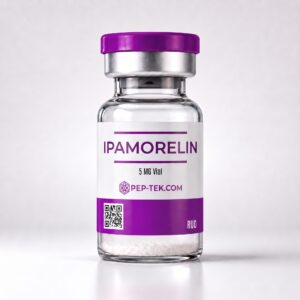
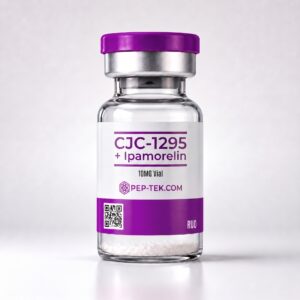
Available from PepTek
Ipamorelin GH pulse research studies reveal how this selective GHRP stimulates pulsatile growth hormone release with high specificity. Key animal model findings are summarized here.
Among the growth hormone-releasing peptides (GHRPs) characterized in the late twentieth and early twenty-first centuries, ipamorelin has attracted sustained scientific interest for its selectivity in stimulating pulsatile growth hormone (GH) secretion. Ipamorelin GH pulse research studies have collectively established a mechanistic and pharmacodynamic profile that distinguishes this pentapeptide from earlier, less selective GHRPs. This article summarizes pivotal published findings, with particular attention to the receptor pharmacology, endocrine specificity, and pulse-regulation data generated in controlled in vitro and animal model settings.
Ipamorelin (Ala-His-D-2-Nal-D-Phe-Lys-NH₂) is a synthetic pentapeptide that acts as an agonist at the growth hormone secretagogue receptor type 1a (GHS-R1a). Unlike first-generation GHRPs such as GHRP-6, ipamorelin was designed to activate GH release without substantially perturbing the secretion of adrenocorticotropic hormone (ACTH), cortisol, or prolactin — a profile considered advantageous for precise endocrine research. For a broader overview of ipamorelin’s receptor pharmacology, researchers may consult the Ipamorelin: Selective GHRP Research Profile on PepTek’s research library.
The selectivity issue is not trivial. GHRP-6 and GHRP-2, earlier members of the class, were found to elevate plasma cortisol and ACTH alongside GH in animal models, complicating efforts to isolate the somatotropic axis as an independent variable. Ipamorelin’s improved selectivity made it a preferred research tool for studies focused specifically on GH pulse architecture.
One of the foundational ipamorelin GH pulse research studies was published by Raun and colleagues in 1998 in the European Journal of Endocrinology [Raun et al., 1998]. The investigators sought to characterize ipamorelin’s GH-releasing potency relative to GHRP-6 and growth hormone-releasing hormone (GHRH) in anesthetized rats, while simultaneously measuring the impact on cortisol, ACTH, and prolactin secretion.
Using intravenous bolus administration in male Sprague-Dawley rats, the study compared dose-response curves for each secretagogue across a range of molar concentrations. Plasma GH, ACTH, and corticosterone were measured at multiple time points following administration using validated radioimmunoassay (RIA) techniques.
The data indicated that ipamorelin produced robust, dose-dependent increases in plasma GH in the rat model, with peak GH values comparable to those elicited by GHRP-6 at equivalent molar doses. Critically, however, ipamorelin at maximally effective GH-releasing doses did not significantly elevate plasma ACTH or corticosterone above vehicle-treated controls, whereas GHRP-6 produced statistically significant increases in both hormones at GH-effective doses. Prolactin was similarly unaffected by ipamorelin in this model [Raun et al., 1998].
This endocrine selectivity profile made ipamorelin a valuable research compound for studies in which investigators wished to examine somatotropic axis physiology without confounding activation of the hypothalamic-pituitary-adrenal (HPA) axis — a distinction with clear relevance to experimental design integrity.
Subsequent ipamorelin GH pulse research studies extended the initial characterization to examine how repeated administration influences the natural pulsatile pattern of GH release. Physiological GH secretion is inherently pulsatile, governed by the interplay between hypothalamic GHRH (stimulatory) and somatostatin (inhibitory). GHRPs, including ipamorelin, are understood to amplify GH pulse amplitude partly through GHS-R1a activation and partly through modulation of somatostatinergic tone [Bowers et al., 1996].
Research in rat models demonstrated that ipamorelin’s GH-releasing effect is synergistic with endogenous GHRH. When administered in a setting where endogenous GHRH tone is present, the peptide augments pulse amplitude without abolishing inter-pulse troughs, suggesting that it does not override the somatostatin-mediated regulatory gate entirely. This preservation of pulsatile architecture is considered a distinguishing characteristic compared to continuous GH pathway stimulation.
An important variable in any repeated-administration research paradigm is receptor desensitization. Studies examining GHRP receptor tachyphylaxis found that ipamorelin, at doses producing consistent GH pulses, showed a relatively modest degree of homologous desensitization at the GHS-R1a compared to some other secretagogues [Muccioli et al., 1998]. This property has made it useful in longer-duration animal model experiments where maintenance of GH pulse fidelity across repeated measurement intervals is methodologically important.
The molecular mechanisms underlying GHS-R1a signaling and its regulation have parallels in other G protein-coupled receptor (GPCR) research contexts. Researchers examining neuroendocrine peptide signaling — such as those studying the Semax: ACTH-Derived Neuropeptide Research Profile — may find the receptor internalization and resensitization dynamics of ipamorelin’s target receptor to be a useful comparative reference point.
A significant portion of ipamorelin GH pulse research studies have examined its behavior when combined with GHRH or GHRH analogues. The mechanistic rationale rests on the complementary nature of GHS-R1a agonism and GHRH receptor (GHRHR) agonism: acting at distinct receptor subtypes on somatotroph cells, the two signals produce supraadditive GH release in animal models [Korbonits & Grossman, 1995].
This synergistic dynamic is central to the research rationale for peptide blends examined in studies such as those reviewed in the CJC-1295 + Ipamorelin Blend: Research Overview of Synergistic Mechanisms article, which details the mechanistic basis for combining a long-acting GHRH analogue with a GHS-R1a agonist. Similarly, researchers may wish to consult the Tesamorelin: GHRH Analogue Research Profile and Studied Effects for comparative data on GHRH-class compounds and their GH-pulse regulatory behavior.
A recurring theme across ipamorelin GH pulse research studies is the methodological importance of sampling frequency. GH pulses in rodents are brief — often peaking within 15–30 minutes of secretagogue administration — requiring high-frequency blood sampling to accurately characterize pulse amplitude, duration, and area under the curve (AUC). Studies relying on sparse sampling have been shown to underestimate peak GH values, potentially confounding comparisons between compounds.
Researchers conducting in vivo animal model studies with ipamorelin are advised by the published literature to employ cannulated preparations allowing serial sampling at 5–10 minute intervals during the expected response window. Automated blood sampling systems described in specialized pharmacokinetic literature provide the temporal resolution necessary to distinguish true GH pulse peaks from inter-pulse baseline values [Bowers et al., 1996].
GH pulse architecture differs substantially between rodent and primate species. The rapid, high-amplitude GH pulses characteristic of rats are not directly translatable to the lower-frequency, lower-amplitude pattern observed in primates. Researchers extrapolating from rodent ipamorelin studies to other species models must account for these baseline differences in neuroendocrine GH regulation when interpreting experimental outcomes.
The broader context of somatotropic axis research intersects with cellular metabolism pathways studied in other research compound profiles. For example, GH exerts downstream effects on cellular energy metabolism that overlap conceptually with the areas examined in the NAD+: Coenzyme Research Profile and Cellular Metabolism Studies, illustrating how distinct research compounds can probe complementary aspects of metabolic physiology in controlled laboratory settings.
The body of ipamorelin GH pulse research studies summarized here represents findings generated exclusively in in vitro systems and animal models under controlled laboratory conditions. These studies have collectively advanced the mechanistic understanding of GHS-R1a-mediated somatotroph activation, pulsatile GH release dynamics, and endocrine selectivity among GHRP-class peptides.
Disclaimer: All information presented in this article is intended strictly for scientific research and educational purposes. Ipamorelin and all related compounds discussed herein are research chemicals supplied by PepTek for laboratory use only. They are not approved for human or animal consumption, are not intended to diagnose, treat, cure, or prevent any disease or medical condition, and should not be used outside of a properly supervised research environment. Nothing in this article constitutes medical advice, dosing guidance, or a therapeutic recommendation of any kind.