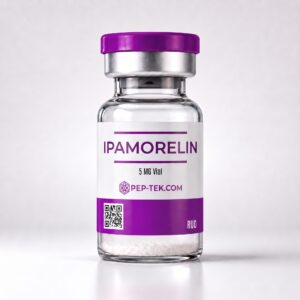
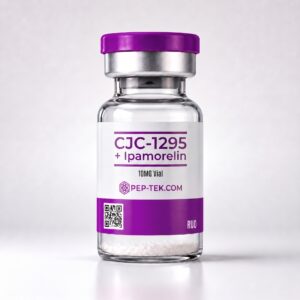
Available from PepTek
Ipamorelin is a selective growth hormone-releasing peptide studied in vitro and in animal models for its targeted GH secretagogue activity and favorable selectivity profile.
Among the compounds investigated in ipamorelin GHRP research, ipamorelin occupies a distinctive position due to its high receptor selectivity and relatively clean stimulatory profile in preclinical models. First characterized in the late 1990s, this synthetic pentapeptide has attracted sustained interest from researchers examining growth hormone secretagogue receptor (GHS-R) pharmacology, pituitary signaling, and downstream metabolic effects in controlled laboratory settings. This profile summarizes the compound’s known mechanisms, research history, and the available preclinical evidence base.
Ipamorelin (Aib-His-D-2-Nal-D-Phe-Lys-NH₂) is a pentapeptide GH secretagogue structurally derived from the GHRP family. It was developed by Novo Nordisk researchers and introduced to the scientific literature principally through the work of Raun et al. in 1998. Unlike earlier GHRPs such as GHRP-6 or GHRP-2, ipamorelin was noted for its selectivity: in animal model studies, it stimulated GH release without producing statistically significant elevations in cortisol or ACTH at equivalent effective doses [Raun et al., 1998].
This selectivity made ipamorelin a valuable tool compound for researchers seeking to isolate GHS-R1a-mediated effects without confounding hormonal responses, and it remains a reference standard in pituitary pharmacology research.
Ipamorelin acts as an agonist at the growth hormone secretagogue receptor type 1a (GHS-R1a), a G-protein coupled receptor expressed predominantly in the pituitary gland and hypothalamus. Receptor activation triggers a Gαq/11-mediated signaling cascade involving phospholipase C, inositol trisphosphate (IP₃) generation, and intracellular calcium mobilization, ultimately promoting the exocytosis of stored GH from pituitary somatotroph cells [Smith et al., 1997].
In vitro binding studies have confirmed that ipamorelin competes with radiolabeled ghrelin for GHS-R1a occupancy, consistent with its classification as a functional ghrelin mimetic. However, structural differences from native ghrelin confer resistance to proteolytic degradation in research buffer systems, which investigators have noted as relevant to its utility in cell-based assay models.
A defining feature highlighted in ipamorelin GHRP research is the compound’s selectivity for GH release over other pituitary hormones. Comparative animal studies demonstrated that while GHRP-6 produced dose-dependent increases in plasma ACTH and cortisol alongside GH, ipamorelin showed a markedly attenuated effect on these axes at GH-stimulating doses [Raun et al., 1998]. Prolactin release was similarly unaffected in the same models, making ipamorelin a preferred tool for researchers aiming to study isolated somatotropic axis activity.
This hormonal selectivity is thought to derive from partial structural differences in receptor contact points relative to less selective GHRPs, though the precise molecular basis continues to be investigated in computational docking and mutagenesis studies.
Ipamorelin emerged from a systematic medicinal chemistry effort at Novo Nordisk in the 1990s to optimize GHRP scaffolds for receptor selectivity and potency. The foundational preclinical paper by Raun and colleagues [Raun et al., 1998] established its in vivo GH-stimulating capacity in rat and swine models and benchmarked its selectivity profile against existing secretagogues. This publication has since become a key reference in the broader GHS-R pharmacology literature.
Subsequent years saw ipamorelin adopted widely as a research tool in academic and pharmaceutical settings, particularly in studies examining GH secretory dynamics, pulsatility, and the interplay between the GHS-R axis and somatostatin tone. Researchers have used ipamorelin to probe hypothalamic-pituitary communication in animal models of altered GH secretion, including aged rodent models where endogenous GH pulsatility is diminished [Veldhuis et al., 2008].
Ipamorelin GHRP research has also intersected with studies on gastrointestinal motility, given the broad expression of GHS-R in the enteric nervous system. Preclinical data in rat models suggested that GHS-R agonists including ipamorelin may influence gastric emptying rates, findings that have informed ongoing mechanistic inquiry into ghrelin receptor biology beyond the pituitary [Greenwood-Van Meerveld et al., 2011].
In rodent and porcine in vivo studies, ipamorelin administration produced rapid, transient GH pulses consistent with physiological secretory patterns. Researchers observed that the GH response was dose-dependent and could be augmented by co-administration of growth hormone-releasing hormone (GHRH), suggesting additive or synergistic interactions at the pituitary level. These findings have been used to model the interplay between GHS-R agonism and endogenous GHRH signaling in normal and suppressed hypothalamic-pituitary axes.
Animal model studies examining longer-term ipamorelin exposure have reported changes in lean mass and adipose tissue distribution in rodents, consistent with downstream IGF-1 axis engagement [Svensson et al., 2000]. These observations are interpreted in the context of GH’s known role in intermediary metabolism and are studied to better understand GHS-R-mediated effects on body composition independent of nutritional variables. It is important to note that all such findings are derived from controlled preclinical settings and carry no established translational implications.
Some preclinical investigations have incorporated bone density measurements in models of ipamorelin exposure, with researchers noting statistically significant increases in bone mineral content in young adult female rats over multi-week observation periods [Svensson et al., 2000]. These findings contribute to the broader literature on GH secretagogue effects on skeletal tissue and are studied as part of understanding GHS-R biology in bone metabolism research.
Ipamorelin is frequently studied alongside other research peptides with distinct but sometimes complementary mechanistic profiles. Researchers investigating tissue-level growth factor signaling may find relevant context in the body of work on BPC-157 peptide research, including its proposed mechanism of action, which explores a different receptor landscape involving growth factor receptor modulation and cytoprotective pathways. Similarly, investigators examining extracellular matrix dynamics and cytoskeletal signaling may reference the literature on TB-500 (Thymosin Beta-4) cellular mechanisms as a complementary model of peptide-mediated tissue-level effects.
Within ipamorelin GHRP research, the compound is often used as a comparator or reference agonist in studies evaluating novel GHS-R ligands, contributing to the structural pharmacology of the ghrelin receptor system.
The totality of ipamorelin GHRP research establishes it as a well-characterized tool compound for GHS-R pharmacology investigations with a reproducible and selective preclinical profile.
Ipamorelin is an active area of ongoing preclinical inquiry within GHS-R biology, pituitary pharmacology, and metabolic research. The evidence summarized in this profile is derived exclusively from in vitro studies and animal model experiments conducted under controlled laboratory conditions. All information presented here is strictly for research and educational purposes. Ipamorelin, as supplied by PepTek, is intended solely for use by qualified researchers in laboratory settings. It is not approved for human or animal consumption, is not a pharmaceutical product, and should not be used as a therapeutic agent. No claims of medical benefit, health improvement, or clinical applicability are made or implied. Researchers should consult applicable institutional guidelines and regulatory frameworks before undertaking any studies involving this compound.