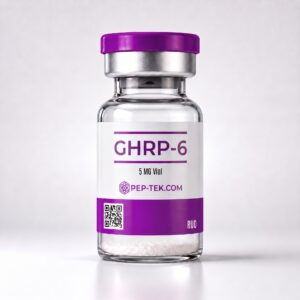
Available from PepTek
GHRP-6 is a synthetic hexapeptide that stimulates growth hormone release via ghrelin receptor activation. This article reviews key preclinical and in vitro research on its mechanisms and studied biological effects.
Among the most extensively studied synthetic secretagogues in peptide research, GHRP-6 (Growth Hormone-Releasing Peptide-6) occupies a foundational position. Understanding what is GHRP-6 growth hormone releasing peptide requires examining both its structural biochemistry and the body of preclinical literature that has characterized its receptor interactions, downstream signaling, and observed biological effects in controlled research settings. This article summarizes key published studies on GHRP-6 and contextualizes them within the broader landscape of growth hormone secretagogue research.
GHRP-6 is a synthetic hexapeptide with the amino acid sequence His-D-Trp-Ala-Trp-D-Phe-Lys-NH₂. It belongs to the growth hormone-releasing peptide family, a class of compounds originally derived from enkephalin analogues during research conducted in the late 1970s and early 1980s. Unlike endogenous growth hormone-releasing hormone (GHRH), which acts through a distinct receptor pathway, GHRP-6 exerts its primary effects through the ghrelin receptor — formally known as the growth hormone secretagogue receptor type 1a (GHS-R1a).
This receptor distinction is significant in research contexts. The GHS-R1a is a G protein-coupled receptor expressed in the hypothalamus, pituitary, and peripheral tissues. Its activation by GHRP-6 triggers intracellular calcium mobilization and second messenger cascades that culminate in growth hormone (GH) secretion from somatotroph cells of the anterior pituitary [Howard et al., 1996].
Researchers interested in the broader category of receptor-targeted synthetic peptides may also find comparative value in reviewing research on Melanotan II (MT-2): Melanocortin Receptor Agonist Research Profile, which similarly illustrates how synthetic peptides engage specific G protein-coupled receptor families to produce measurable downstream effects in animal models.
One of the most cited foundational studies on what is GHRP-6 growth hormone releasing peptide at a mechanistic level was published by Howard and colleagues in 1996 in Science. Using molecular cloning techniques, the research team identified and characterized the GHS-R1a receptor as the primary binding target for synthetic GH secretagogues including GHRP-6. Their work demonstrated that GHRP-6 binding to GHS-R1a in rat pituitary cell cultures produced significant, dose-dependent GH release in vitro, a finding that established the receptor pharmacology underpinning subsequent GHRP research [Howard et al., 1996].
A well-documented phenomenon in GHRP-6 research is its synergistic interaction with endogenous or exogenous GHRH. Bowers and colleagues demonstrated in multiple studies that co-administration of GHRP-6 and GHRH in animal models produced GH release substantially greater than either compound alone. This synergy is thought to arise from GHRP-6’s dual action: direct pituitary stimulation via GHS-R1a and simultaneous suppression of somatostatin tone at the hypothalamic level [Bowers et al., 1991]. This mechanistic pairing has informed the design of combination secretagogue research, as explored in related research on the CJC-1295 + Ipamorelin Blend: Research Overview of Synergistic Mechanisms.
Beyond its classical secretagogue role, a growing body of preclinical research has investigated GHS-R1a-independent effects of GHRP-6. Notably, Granado and colleagues published findings in 2014 demonstrating that GHRP-6 administration in rodent models of sepsis-induced organ injury was associated with attenuated inflammatory cytokine expression and reduced apoptotic markers in cardiac and hepatic tissue. The researchers proposed that these effects involved activation of the PI3K/Akt survival signaling pathway, independent of GH secretion [Granado et al., 2014]. These observations have positioned GHRP-6 as a subject of interest in preclinical tissue-protection research.
In the context of peptide research examining cytoprotective mechanisms, it is also worth noting parallel investigations into compounds such as BPC-157 Peptide: Research Profile and Mechanism of Action, which similarly engage survival signaling pathways in animal model studies.
Several in vivo animal studies have examined GHRP-6’s effects in cardiovascular stress models. Research published by Berlanga and colleagues investigated GHRP-6 in rat models of myocardial infarction, observing reductions in infarct size and improved functional parameters compared to controls. The authors attributed these findings to GHRP-6’s apparent ability to reduce oxidative stress markers and limit cardiomyocyte apoptosis following ischemic challenge [Berlanga et al., 2007]. As with all such animal model data, these findings require cautious interpretation and do not constitute evidence of clinical efficacy.
Understanding what is GHRP-6 growth hormone releasing peptide also involves situating it relative to structurally and functionally related compounds that have been developed in the decades since its characterization. Ipamorelin, for instance, is a more selective GHS-R1a agonist that was developed in part to limit the cortisol and prolactin co-secretion observed with GHRP-6 in animal models. Research on Ipamorelin: Selective GHRP Research Profile provides a useful counterpoint for researchers examining selectivity across the GHRP compound family.
Similarly, Tesamorelin — a GHRH analogue with a distinct mechanism of action — has been studied extensively as a GH axis modulator. Researchers comparing GHRH pathway activation versus direct GHS-R1a agonism will find comparative data in the Tesamorelin: GHRH Analogue Research Profile and Studied Effects article.
Because GHRP-6 acts on the ghrelin receptor, researchers have observed appetite-stimulating effects in animal model studies consistent with ghrelin’s known orexigenic properties. Studies in rodent models have reported increased food-seeking behavior and caloric intake following GHRP-6 administration, an effect mediated through GHS-R1a expressed in hypothalamic hunger-regulating circuits [Wren et al., 2001]. This property distinguishes GHRP-6 growth hormone releasing peptide research from investigations into more selective secretagogues that do not engage orexigenic pathways to the same degree.
The GH axis has broad intersections with metabolic regulation, including insulin sensitivity, lipid metabolism, and cellular energy dynamics. Research into GHRP-6’s influence on GH pulsatility in animal models inherently touches on these metabolic networks. For researchers interested in the broader landscape of metabolic signaling research, related compound profiles such as NAD+: Coenzyme Research Profile and Cellular Metabolism Studies provide complementary mechanistic context regarding how cellular energy and signaling pathways intersect in preclinical research models.
Contemporary research involving what is GHRP-6 growth hormone releasing peptide as a study subject has expanded beyond simple secretagogue characterization. Active preclinical investigation areas include:
These research directions reflect GHRP-6’s multifaceted receptor biology and the growing recognition that GHS-R1a activation produces pleiotropic cellular effects beyond GH secretion alone. All findings cited in this context remain at the preclinical stage and have not been validated in controlled human clinical trials.
The studies summarized in this article represent a cross-section of preclinical and in vitro research on GHRP-6 growth hormone releasing peptide. All findings referenced are derived from animal model studies or cell culture experiments. Researchers working with GHRP-6 should consult the primary literature directly and apply findings only within appropriate controlled research frameworks.
Disclaimer: GHRP-6, as supplied by PepTek, is intended strictly for laboratory and preclinical research purposes. It is not approved for human or animal consumption, and nothing in this article should be interpreted as medical advice, a therapeutic claim, or a recommendation for any clinical application. All research use must comply with applicable institutional, regulatory, and ethical guidelines.