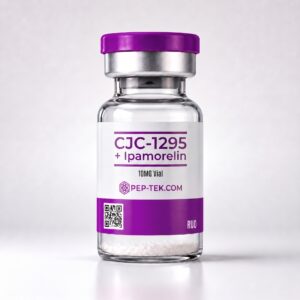
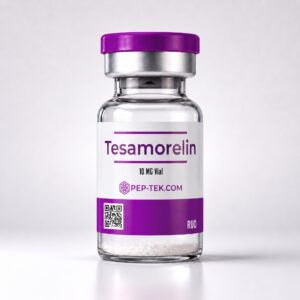
Available from PepTek
CJC-1295 and tesamorelin are GHRH analogues studied for distinct receptor binding profiles and half-lives. This comparison examines their structural differences, mechanisms, and research applications.
Growth hormone-releasing hormone (GHRH) analogues represent a significant area of peptide research, with scientists investigating how structural modifications to the native GHRH sequence influence receptor binding affinity, plasma half-life, and downstream signaling outcomes. Among the most studied compounds in this class are CJC-1295 and tesamorelin — two synthetic peptides that share a common biological target yet differ substantially in their molecular architecture and observed research profiles. Understanding the nuances of CJC-1295 vs tesamorelin GHRH research is essential for investigators selecting the appropriate tool compound for their experimental models.
This article is intended strictly for scientific research purposes. All information pertains to in vitro and preclinical animal model research only.
Endogenous GHRH is a 44-amino acid peptide secreted by the hypothalamus that stimulates somatotroph cells in the anterior pituitary to synthesize and release growth hormone (GH). The native molecule, while biologically potent, is rapidly degraded in plasma — primarily by the enzyme dipeptidyl peptidase IV (DPP-IV) — yielding a half-life of only a few minutes. This instability has driven researchers to develop more durable analogues for use in experimental settings [Frohman et al., 1989].
Tesamorelin is a synthetic peptide consisting of the full 44-amino acid sequence of human GHRH with the addition of a trans-3-hexenoic acid group at the N-terminus. This single chemical modification confers meaningful resistance to DPP-IV cleavage while preserving the full receptor-binding domain of the native molecule. Researchers have observed that tesamorelin maintains high selectivity for the GHRH receptor (GHRHR) with minimal off-target interactions. For a more detailed examination of tesamorelin’s studied properties, see PepTek’s Tesamorelin: GHRH Analogue Research Profile and Studied Effects.
CJC-1295 (also known as DAC:GRF) takes a markedly different engineering approach. It is based on a truncated, modified GHRH sequence — specifically a 30-amino acid analogue — that incorporates several amino acid substitutions to resist enzymatic degradation, along with a maleimidoproprionic acid (MPA) side chain that facilitates covalent binding to circulating albumin. This Drug Affinity Complex (DAC) technology dramatically extends the peptide’s effective half-life, with animal model studies indicating plasma persistence measured in days rather than minutes [Jetté et al., 2005]. Researchers interested in how CJC-1295 interacts with complementary secretagogues may consult PepTek’s article on the CJC-1295 + Ipamorelin Blend: Research Overview of Synergistic Mechanisms.
Both CJC-1295 and tesamorelin act as agonists at the GHRH receptor, a G-protein-coupled receptor (Gs-coupled) expressed predominantly on anterior pituitary somatotrophs. Receptor activation triggers adenylyl cyclase, elevating intracellular cyclic AMP (cAMP), which in turn activates protein kinase A (PKA) pathways and promotes GH synthesis and pulsatile secretion. Downstream, GH stimulates hepatic and peripheral production of insulin-like growth factor 1 (IGF-1), which mediates many of the anabolic and metabolic effects observed in preclinical models [Thorner et al., 1997].
A critical distinction in CJC-1295 vs tesamorelin GHRH research lies in how each compound shapes GH secretory dynamics. Tesamorelin, with a relatively shorter effective half-life compared to CJC-1295, is observed to stimulate more discrete GH pulses that better approximate physiological pulsatile secretion. Researchers studying models where temporal GH pulse architecture is an important variable may find tesamorelin particularly useful for this reason.
CJC-1295’s albumin-binding DAC technology produces a sustained elevation of GHRH-receptor stimulation. Animal model studies have demonstrated that a single administration of CJC-1295 can produce measurable elevations in mean plasma GH and IGF-1 levels for up to six days [Jetté et al., 2005]. This prolonged action is advantageous in experimental contexts where sustained GH axis stimulation is the research objective, but it also introduces a more tonically elevated rather than pulsatile GH environment — a consideration that may affect experimental design and interpretation.
Much of the published literature on tesamorelin in controlled research settings has focused on visceral adipose tissue dynamics and lipid metabolism parameters. In vitro and animal model studies suggest tesamorelin’s GHRHR agonism influences lipolytic pathways in visceral fat depots [Falutz et al., 2010]. Researchers examining metabolic signaling pathways may also find it valuable to consider how GH-axis compounds interact with broader energy metabolism frameworks — a topic explored in PepTek’s NAD+: Coenzyme Research Profile and Cellular Metabolism Studies.
CJC-1295, by contrast, has been more prominently used in research contexts examining sustained GH and IGF-1 axis modulation, muscle protein synthesis signaling, and recovery biology models in animal systems. Its extended half-life makes it a practical tool for experiments requiring persistent GH axis elevation without frequent dosing in animal subjects.
Both compounds demonstrate high selectivity for GHRHR with limited studied interactions at other receptor classes. Tesamorelin’s structural identity to native GHRH supports a well-characterized receptor binding profile. CJC-1295’s amino acid substitutions (including Ala2 substitution to prevent DPP-IV cleavage, and substitution at positions 8, 15, and 27 for stability) are designed to preserve GHRHR selectivity while improving pharmacokinetic behavior [Jetté et al., 2005]. Researchers should account for the potential influence of sustained IGF-1 elevation on insulin signaling pathways when designing experiments with CJC-1295.
For comparison, researchers studying other receptor-selective peptides such as growth hormone-releasing peptides (GHRPs) may find the Ipamorelin: Selective GHRP Research Profile useful context, as GHRPs engage GHS-R1a rather than GHRHR, representing a distinct mechanistic pathway that is sometimes studied alongside GHRH analogues in combinatorial models.
Selecting between these two compounds for CJC-1295 vs tesamorelin GHRH research protocols typically depends on several investigator priorities:
Some research frameworks situating GHRH analogue studies within broader cellular biology contexts have noted that GH and IGF-1 axis signaling intersects with oxidative stress regulation and redox homeostasis. Investigators contextualizing their CJC-1295 vs tesamorelin GHRH research within cellular metabolism models may find it informative to review related antioxidant pathway research such as PepTek’s article on Glutathione: Tripeptide Antioxidant Research and Redox Signaling.
The comparative analysis of CJC-1295 vs tesamorelin GHRH research underscores how targeted structural modifications to a parent peptide sequence can produce meaningfully different pharmacokinetic and pharmacodynamic profiles, even when the fundamental receptor target remains the same. Both compounds continue to serve as important tool molecules in preclinical and in vitro research examining the GH/IGF-1 axis.
Research Use Disclaimer: All information presented in this article is intended exclusively for scientific research purposes. CJC-1295 and tesamorelin, as supplied by PepTek, are research compounds not approved for human or animal consumption, therapeutic use, or clinical application. Neither compound should be administered to humans or animals outside of appropriately sanctioned research settings. No claims of medical benefit, therapeutic efficacy, or health improvement are made or implied. Researchers should comply with all applicable institutional, regulatory, and ethical guidelines governing the use of research peptides. PepTek provides these compounds solely for in vitro and legitimate preclinical research use.