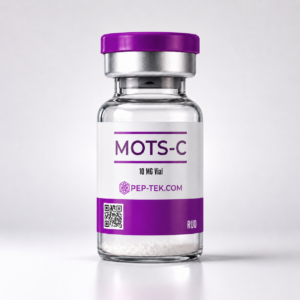
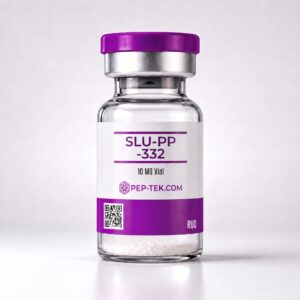
Available from PepTek
MOTS-C vs SLU-PP-332 metabolic research highlights two distinct pathways—mitochondrial peptide signaling and nuclear ERR agonism—offering researchers complementary tools for studying energy homeostasis.
The field of metabolic research has expanded considerably with the identification of compounds that modulate energy homeostasis through fundamentally different biological axes. MOTS-C vs SLU-PP-332 metabolic research represents a compelling area of comparative inquiry, juxtaposing a mitochondria-derived peptide against a small-molecule nuclear receptor agonist. Understanding their structural origins, distinct mechanisms, and divergent downstream effects equips researchers with a clearer framework for experimental design when studying cellular energy regulation, insulin sensitivity, and mitochondrial biogenesis.
MOTS-C (Mitochondrial Open Reading Frame of the 12S rRNA-c) is a 16-amino acid peptide encoded within the mitochondrial genome—specifically within the 12S ribosomal RNA gene. Its sequence (MRWQEMGYIFYPRKLR) is conserved across mammalian species, underscoring its evolutionary significance [Lee et al., 2015]. Unlike nuclear-encoded peptides, MOTS-C is synthesized within the mitochondrial matrix and can translocate to the cytoplasm and nucleus under metabolic stress conditions. Its relatively small molecular weight (~2.2 kDa) and peptide architecture distinguish it from most signaling molecules and place it in the emerging class of mitochondrial-derived peptides (MDPs).
SLU-PP-332 is a synthetic small molecule developed as a pan-agonist of estrogen-related receptors (ERRα, ERRβ, and ERRγ). Structurally, it bears no resemblance to a peptide; rather, it is a low-molecular-weight organic compound designed to occupy the ligand-binding domain of ERR nuclear receptors. Its development arose from efforts to pharmacologically activate transcriptional programs associated with endurance exercise adaptation [Zuercher et al., 2005; Dufour et al., 2007]. SLU-PP-332 acts upstream of key transcription factors including PGC-1α, giving it broad influence over nuclear gene expression networks that govern oxidative metabolism.
In vitro and animal model studies indicate that MOTS-C exerts its primary effects by activating AMP-activated protein kinase (AMPK), a master regulator of cellular energy balance. Researchers have observed that MOTS-C inhibits the folate cycle and de novo purine synthesis, leading to accumulation of AICAR (5-aminoimidazole-4-carboxamide ribonucleotide), a known AMPK activator [Lee et al., 2015]. This mechanism results in downstream effects including enhanced glucose uptake, fatty acid oxidation, and mitochondrial quality control. In murine models, exogenous MOTS-C administration has been associated with improved insulin sensitivity and resistance to high-fat diet-induced metabolic dysfunction.
Notably, MOTS-C also translocates to the nucleus under stress conditions, where it interacts with the antioxidant response element (ARE) pathway. This positions it as a compound of interest in studies examining the intersection of mitochondrial signaling and nuclear gene regulation—a research dimension also explored in the context of NAD+ coenzyme research and cellular metabolism studies, where mitochondrial redox state plays a central regulatory role.
SLU-PP-332 operates through an entirely different axis. By directly binding and activating ERRα, ERRβ, and ERRγ, it initiates transcriptional programs that upregulate genes involved in oxidative phosphorylation, mitochondrial biogenesis, and fatty acid oxidation [Dufour et al., 2007]. Animal model studies indicate that SLU-PP-332 treatment leads to increased expression of PGC-1α target genes, enhanced mitochondrial density in skeletal muscle, and improvements in exercise capacity in sedentary murine models [Kim et al., 2023]. Because ERRs function as ligand-activated transcription factors without a known endogenous ligand, SLU-PP-332 provides a tool for constitutively activating these receptors in a research setting.
This top-down, transcription-first mechanism contrasts sharply with MOTS-C’s bottom-up, metabolite-driven AMPK activation. The downstream metabolic outcomes may appear superficially similar—both converge on improved mitochondrial function—but the signaling architectures are fundamentally distinct, making them valuable as independent experimental variables in MOTS-C vs SLU-PP-332 metabolic research.
MOTS-C is typically selected when investigators seek to study the signaling crosstalk between mitochondria and the nucleus, or when the research question centers on endogenous mitochondrial peptide biology. Its peptide nature makes it amenable to isotopic labeling, receptor binding studies, and cell-penetrating peptide analog design. Researchers studying age-related metabolic decline have also employed MOTS-C in aged murine models, as circulating MOTS-C levels have been reported to decline with age [Reynolds et al., 2021]. Its relevance to insulin-resistant models has made it a point of comparison in studies alongside other metabolically active peptide compounds.
Researchers investigating broader hormonal and peptide interactions in metabolic contexts—for example, those studying GLP-1/GIP dual agonist mechanisms such as tirzepatide—may find MOTS-C a useful comparative reference point for peptide-based metabolic intervention research.
SLU-PP-332 is preferred when research questions involve nuclear receptor pharmacology, transcriptional reprogramming, or exercise biology at the genomic level. Its small-molecule format permits straightforward in vitro cell culture application with predictable bioavailability characteristics. Investigators focused on skeletal muscle fiber type switching, cardiac hypertrophy models, or mitochondrial disease research have found SLU-PP-332’s ERR agonism particularly informative. Because it operates upstream of PGC-1α, it can be layered with other interventions to dissect transcriptional hierarchies in energy metabolism.
In MOTS-C vs SLU-PP-332 metabolic research, the choice is rarely binary in sophisticated experimental designs. Several published studies have utilized both AMPK activators and ERR agonists within complementary experimental arms to triangulate the metabolic phenotype under investigation, reinforcing the value of understanding each compound’s unique mechanistic signature.
Some research groups have explored whether AMPK activation (as induced by MOTS-C) and ERR agonism (as induced by SLU-PP-332) produce additive or synergistic transcriptional outcomes. Early in vitro data suggest partial pathway convergence at the level of PGC-1α co-activation, though the upstream triggers remain independent [Reynolds et al., 2021]. This intersection may be of particular interest to investigators studying mitochondrial biogenesis in sarcopenia models or in the context of metabolic syndrome research. For broader context on mitochondrial coenzyme research that intersects with both pathways, researchers may also reference NAD+ cellular metabolism studies, given NAD+’s role as a shared downstream effector of both AMPK and ERR-driven programs.
The comparative analysis of MOTS-C vs SLU-PP-332 metabolic research illustrates how structurally diverse compounds—one a mitochondria-derived peptide, the other a synthetic nuclear receptor agonist—can engage overlapping metabolic outcomes through entirely distinct molecular pathways. This mechanistic divergence is precisely what makes them valuable as independent tools in controlled experimental settings. Researchers studying energy homeostasis, mitochondrial biology, or metabolic disease models will find each compound offers unique investigational advantages depending on the biological question at hand.
As interest in mitochondrial-nuclear signaling continues to grow, MOTS-C vs SLU-PP-332 metabolic research is likely to remain an active area of inquiry, with future studies expected to clarify pathway interactions, tissue-specific effects, and combinatorial models in greater detail.
Research Use Disclaimer: All compounds discussed in this article, including MOTS-C and SLU-PP-332, are intended strictly for in vitro and preclinical research purposes. They are not approved for human or animal consumption, and nothing in this article constitutes medical advice, dosing guidance, or therapeutic recommendations. PepTek supplies these compounds exclusively to qualified researchers for laboratory use in compliance with applicable regulations.