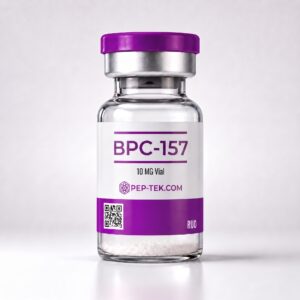
Available from PepTek
BPC-157 is a synthetic pentadecapeptide derived from a gastric protein, studied extensively in preclinical models for its effects on tissue repair, angiogenesis, and cytoprotection.
BPC-157 peptide research has grown substantially over the past three decades, attracting the attention of biochemists, pharmacologists, and molecular biologists interested in understanding the signaling pathways that govern tissue homeostasis and repair. Originally identified as a partial sequence of the endogenous gastric protein BPC (Body Protection Compound), this 15-amino acid synthetic peptide — with the sequence Gly-Glu-Pro-Pro-Pro-Gly-Lys-Pro-Ala-Asp-Asp-Ala-Gly-Leu-Val — has become a prominent subject in preclinical research due to its observed stability and bioactivity across multiple experimental systems.
The origins of BPC-157 trace back to work conducted in the 1990s at the University of Zagreb, where researchers studying the gastroprotective properties of gastric juice identified a protein fraction demonstrating remarkable cytoprotective activity. The isolated peptide was subsequently synthesized and designated BPC-157 for systematic study. Early investigations published by Sikiric and colleagues established foundational observations about the compound’s stability in aqueous environments — a property that distinguished it from many naturally occurring peptides prone to rapid enzymatic degradation [Sikiric et al., 1997].
These initial findings catalyzed a broad program of animal model research examining how the peptide interacted with various physiological systems. Subsequent decades of BPC-157 peptide research have expanded from gastrointestinal models into musculoskeletal, neurological, and vascular contexts, all within preclinical experimental frameworks.
One of the most consistently reported mechanisms in BPC-157 preclinical literature involves modulation of the nitric oxide (NO) signaling system. Animal model studies indicate that BPC-157 may upregulate endothelial nitric oxide synthase (eNOS) expression, thereby influencing local vascular tone and endothelial function. Researchers have observed that this pathway appears to contribute to the peptide’s observed effects on blood flow and tissue perfusion in injured tissue beds [Sikiric et al., 2016].
In vitro studies suggest that BPC-157 may interact with vascular endothelial growth factor (VEGF) receptor signaling cascades. Research using cell culture models has demonstrated that the peptide can upregulate VEGF expression in fibroblast populations, potentially contributing to observed angiogenic activity in wound healing models. Additionally, researchers have examined interactions with the epidermal growth factor receptor (EGFR) pathway as a possible contributor to epithelial repair responses observed in gastrointestinal tissue models [Huang et al., 2015].
More recent molecular investigations have focused on the focal adhesion kinase (FAK) and paxillin signaling axis as a putative target of BPC-157 activity. In vitro work suggests the peptide may activate FAK phosphorylation, promoting cytoskeletal reorganization and cell migration — processes central to wound closure and tissue remodeling. This mechanism has been proposed as a unifying explanation for the diverse tissue types in which BPC-157 peptide research has recorded cytoprotective or repair-associated observations [Chang et al., 2011].
The most extensively studied property of BPC-157 across published literature is its apparent cytoprotective activity in gastrointestinal tissue. Animal model studies — predominantly in rodents — have observed that administration of BPC-157 is associated with attenuated mucosal injury in models of ulceration, inflammatory bowel disease simulation, and pharmacologically induced gut damage. Researchers have noted that these effects appear to occur independently of acid suppression, suggesting a mechanism distinct from conventional gastroprotective compounds.
A significant portion of BPC-157 peptide research has been directed at musculoskeletal tissue, particularly tendon repair models. Studies using surgically transected or chemically injured tendons in rodent models have reported accelerated collagen organization, increased fibroblast activity, and enhanced tensile strength recovery in BPC-157-treated animals compared to controls. Researchers have hypothesized that upregulation of growth factor receptor pathways and promotion of angiogenesis at the injury site may underlie these observations [Brcic et al., 2009].
Preclinical investigations have also examined BPC-157 in models of neurological injury and neurotoxicity. Animal studies have observed apparent attenuation of dopaminergic system disruption in models involving neurotoxic agents, as well as potential effects on serotonergic signaling. These neurological investigations remain at an early stage, and researchers caution that extrapolation beyond the specific experimental conditions studied is not scientifically warranted. Nevertheless, the data have positioned BPC-157 as a subject of continued interest in neuropharmacological research.
Multiple animal model studies have reported that BPC-157 promotes formation of new blood vessels in ischemic or injured tissue. Using dorsal skin window chamber models and other in vivo vascular imaging approaches, researchers have documented increased capillary density and accelerated vessel maturation in BPC-157-treated experimental groups. These angiogenic properties are thought to be mechanistically connected to the VEGF and eNOS pathways described above [Sikiric et al., 2016].
A notable feature of BPC-157 that has attracted research interest is its reported stability in biological fluids. Unlike many endogenous peptides that are rapidly cleaved by proteases, BPC-157 demonstrates relative resistance to degradation in gastric juice and plasma under experimental conditions. This property makes it a useful tool compound for studying peptide-mediated signaling in complex biological environments, and has contributed to its widespread adoption as a research probe in preclinical experimental designs.
Pharmacokinetic data from animal studies suggest the peptide distributes to peripheral tissues following systemic administration in experimental settings, though the precise distribution profile and metabolic fate in mammalian systems remain subjects of ongoing BPC-157 peptide research.
Despite the substantial volume of preclinical data, it is important for researchers to recognize several critical limitations in the current evidence base. The majority of published BPC-157 studies originate from a limited number of research groups, and independent replication across diverse institutions remains limited. Furthermore, virtually all mechanistic and efficacy data derive from in vitro systems or animal models — primarily rodents — and cannot be extrapolated to predict activity or safety in other contexts.
No peer-reviewed clinical trial data in human populations have been published to date. BPC-157 peptide research therefore remains firmly within the domain of exploratory preclinical science, and the compound is classified as a research tool rather than a validated therapeutic agent.
BPC-157 is available from PepTek exclusively as a research compound intended for use in qualified laboratory settings. All information presented in this profile is derived from published preclinical literature and is provided for scientific and educational reference only. BPC-157 is not approved by the FDA or any regulatory agency for human or animal use, and it is not intended for consumption, clinical application, or any use outside of controlled in vitro or animal research protocols conducted by trained scientific professionals. Researchers interested in working with this compound are encouraged to review the primary literature independently and to adhere to all applicable institutional and regulatory guidelines governing research compound use.